This section was reviewed by Dr. Foued Hamza , a surgeon specializing in plastic, reconstructive, and aesthetic surgery. This section review falls within his area of expertise; articles are constantly evolving and not all are individually reviewed.
Which doctor should you consult for lipedema? The process can be confusing: some patients are referred to nutritionists, others to vascular medicine specialists, or directly to a surgical clinic. However, there is no official medical title specifically for "lipedema specialist." The appropriate referral depends on the individual's specific needs: confirming the diagnosis, investigating for an associated condition, relieving symptoms, or discussing surgery.
This page explains the role of each healthcare professional and how to verify their qualifications. It complements our medical guide to lipedema.
Which doctor should I consult for undiagnosed lipedema?
The attending physician organizes the initial triage
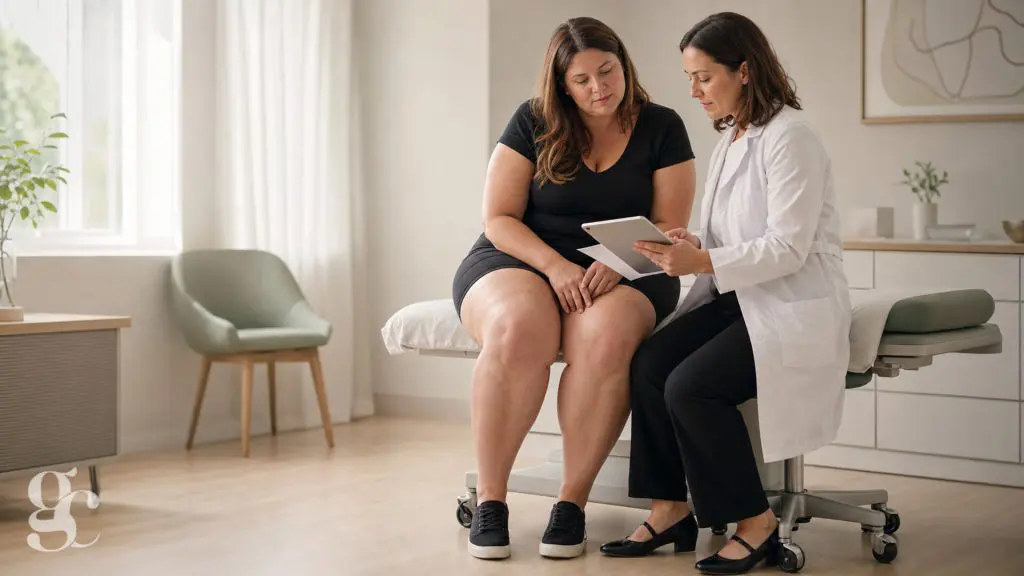
The attending physician reviews the patient's history, examines the limbs, and looks for more frequent or urgent causes of pain and swelling. They may also review treatments, medical history, and the impact on mobility before referring the patient to the appropriate specialist.
A consultation should not begin with a promise of surgery
A diagnosis based on a few photographs or a commercial form is insufficient. The examination must consider the differential diagnoses presented in our lipedema or lymphedema section.
Advertising
What is the role of the vascular physician?
The vascular physician, sometimes also called an angiologist or phlebologist, assesses venous and lymphatic circulation. They may look for venous insufficiency, a history of thrombosis, associated lymphedema, or another cause of swelling.
A Doppler ultrasound may be recommended depending on the signs. This examination alone does not confirm lipedema; it primarily helps to understand what might be coexisting or otherwise explain the symptoms.
When should you consult a lymphedema or rehabilitation team?
When associated edema is suspected
A team specializing in lymphatic disorders can be helpful if the feet or hands swell, if the volume becomes asymmetrical, or if a history of surgery has impaired drainage. They will assess the need for specific tests and treatments.
When mobility or pain limits daily life
Physical medicine and rehabilitation can coordinate a program focused on function, joints, adapted activity, and independence. The goal is not to "correct" a physique, but to improve measurable difficulties.
Which professional chooses compression?
The doctor specifies the indication and precautions. An orthotist or a professional trained in compression takes measurements, proposes the device corresponding to the prescription, and checks its fit. A regular clothing size is not sufficient.
The guide on compression garments for lipedema explains the difference between an individualized medical device and leggings sold online.
Advertising
What role for the physiotherapist?
The physiotherapist can address mobility, activity, pain, and, when a lymphatic component warrants it, certain prescribed decongestive techniques. Drainage should not be presented as a method that eliminates the fat in lipedema.
A serious professional defines an observable objective and reassesses the value of the treatment. Continuing a costly intervention indefinitely without identified benefit is not a personalized strategy.
When should you seek a surgical opinion?
After a complete diagnostic evaluation
The French National Health Insurance (Assurance Maladie) indicates that surgery may be considered when lipedema is significant and continues to cause problems despite appropriate symptomatic treatment. NICE remains more cautious and considers the evidence still insufficient. This difference in opinion needs to be clearly explained.
With a surgeon whose specialty is verifiable
For liposuction, seek a qualified surgeon specializing in the procedure and practicing in a suitable setting. Ask about their stated experience, selection protocol, complications, follow-up care, and the solutions they offer in case of problems. Qualifications, the location of the procedure, and postoperative care should be verifiable separately.
How to verify a doctor in the RPPS?
The Digital Health Agency's Health Directory allows you to search for a professional and verify their professional identity, RPPS number, profession, specialty, and practice locations. This official information confirms a declared qualification, not a specific outcome level for lipedema.
- Compare the name, specialty, and address with the consultation website.
- Verify that the establishment advertised corresponds to the place of practice.
- Ask who will be providing the anesthesia and post-procedure follow-up.
- Don't confuse a social media presence with a qualification.
Advertising
How can we recognize truly documented expertise?
The RPPS (French National Directory of Professional Health Professionals) does not register a "lipedema specialization." Specific experience must therefore be documented with publicly available and dated information: explicitly described clinical activity, participation in a team, scientific work, training, or detailed information about the career path. A simple marketing mention is not sufficient.
A future GuideChirurgie directory will have to distinguish between "identity verified in the RPPS" and "publicly documented management of lipedema", without disguised paid ranking or promise of results.
When to seek a second opinion?
A second opinion is particularly useful when the proposed diagnoses differ, when a major intervention is being considered, or when the expected benefit remains vaguely defined. The goal is not to endlessly multiply consultations, but to compare objective elements: the final diagnosis, alternatives, risks, follow-up, and criteria for improvement.
Provide both professionals with the same reports and ask each to explain any uncertainties. An independent opinion is more informative if it is not contingent on the immediate sale of a package, device, or procedure.
The Health Directory confirms the declared identity and specialty, but it does not certify any specific expertise in lipedema, nor any success rate. Specific experience must be directly examined and considered within the context of the overall quality of care.
Finally, request that the important findings be written down. A written report facilitates coordination with the referring physician and allows for a clear understanding of the reasons for the referral.
What should I prepare before the appointment?
- the approximate date of onset and the evolution of symptoms;
- painful areas and activities that have become difficult;
- venous, lymphatic, joint and surgical history;
- treatments, compressions or care already tried;
- the available tests and prescriptions;
- questions about diagnosis and alternatives.
Our printable lipedema questionnaire can be used to summarize the affected areas, pain, bruising and medical history to be given to the professional.
The pre-operation checklist and the clinic checklist only become useful if a surgical plan is actually chosen.
To track your progress from one healthcare professional to another, our Lipoedema Monitoring Booklet (printable forms available for purchase) keeps track of appointments, opinions received, and requests for coverage. It does not replace the advice of your treating physicians.
What warning signs should raise concern?
Be wary of a definitive diagnosis given remotely, a proposed procedure before any assessment, a claim that a cure is guaranteed, pressure to pay a deposit quickly, or a refusal to explain the risks and follow-up care. A second opinion is perfectly legitimate before non-urgent surgery.