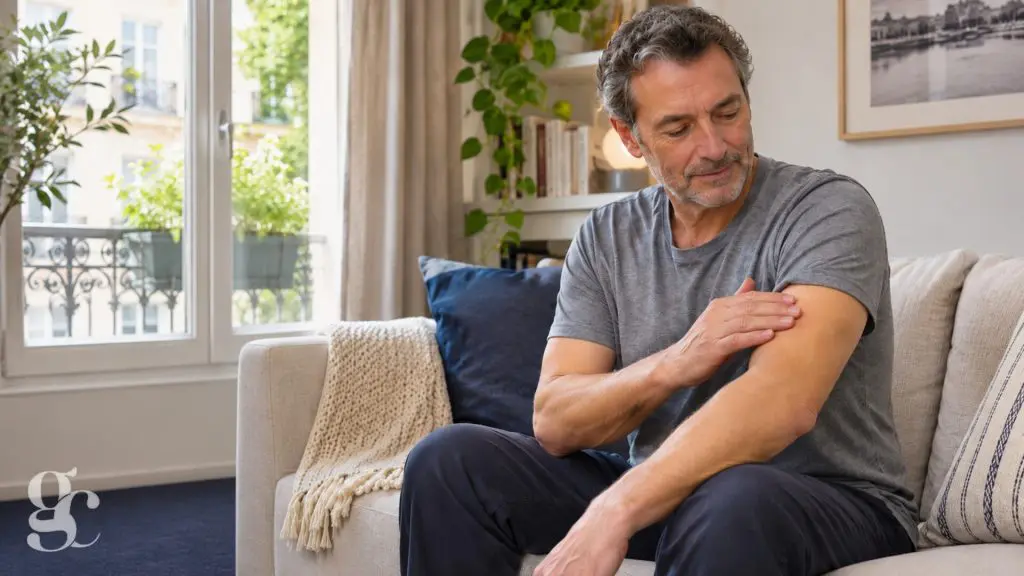
Electric shocks, tingling, or numbness around the scar are common after surgery: when making the incision, the surgeon inevitably cuts small nerves. According to information sheets from British hospitals, these sensations generally lessen over the course of weeks or months. Here's what causes them, what can help with a sensitive scar, and when you should call the medical team.
Quick answer
The dermatology department at Royal Berkshire (NHS) writes that all skin surgery severs small nerves, and that numbness, tingling, or other sensations around the wound can last for several weeks, sometimes months. The French Society of Plastic Surgery lists localized sensory disturbances, such as numbness or tingling, among the possible after-effects.
A scar that has become too sensitive to touch can be treated, once the wound has closed, through touch and massage: this is the desensitization process described by hospitals in Plymouth and Great Ormond Street Hospital. A red, hot, swollen, or oozing scar, or a fever, should be reported to the team.
| What you feel | Rather reassuring | Note |
|---|---|---|
| Numb area | Around the scar, which shrinks over time | That which extends, or a weakness of the limb |
| Tingling, discharges | In short, by touch or movement | Which increase instead of decreasing |
| Scar | Closed, clean | Red, hot, swollen, flowing |
| Pain | It diminishes day by day | Increases, with fever |
I am not a doctor. This guide compiles information from the UK's National Health Service (NHS), Great Ormond Street Hospital, and the French Society of Plastic Surgery to help you prepare your questions. The written instructions provided by your team always take precedence.
Electric shocks after an operation: why?
Small nerves severed by the incision
The skin contains many tiny nerves that transmit touch, heat, and cold. Royal Berkshire reminds us that any incision inevitably severs these nerves. The area they served then becomes less sensitive, or even numb, around the scar or slightly beyond.
Nerves that regenerate and send disordered signals
As nerve endings heal, they can become overly sensitive. Plymouth Hospital and Great Ormond Street Hospital explain that this hypersensitivity stems from damaged nerve endings, which can continue to send pain signals even after healing. This results in tingling, burning, or brief electric shock sensations, triggered by clothing friction or touch.
After which operations?
All of them: a skin procedure, a laparoscopy, a prosthesis, breast, hand, or abdominal surgery. The area affected depends on the nerve pathways. After carpal tunnel surgery, sensation in the fingers has its own specific landmarks: see the post-carpal tunnel surgery care section.
Advertising
How long do these sensations last?
According to the Royal Berkshire Society, numbness, tingling, and other sensations can last for a few weeks, and sometimes months. The French Society of Plastic Surgery describes a white, supple, and painless scar as the natural healing process: a small area may therefore remain permanently less sensitive, without causing any problems. Your surgeon can tell you what to expect after your procedure.
How to desensitize an overly sensitive scar
Plymouth hospitals advise that you should start touching and massaging the scar once the wound has healed. Great Ormond Street Hospital warns that if you avoid touching a sensitive scar, it may remain so. The information sheets describe several techniques:
- massage the scar with a fragrance-free moisturizing cream, using circular motions and pressing firmly;
- rub the area with increasingly rough materials, starting with cotton and then felt;
- gently and quickly tap the area with your fingers;
- For a hand or foot, immerse the area in a bowl of rice or lentils;
- Observe the area during the exercise, in a quiet place.
Both fact sheets advise repeating these movements several times a day, in short sessions. Great Ormond Street Hospital notes that it can sometimes be uncomfortable at first: if it's too painful, apply less pressure or take a break. If the sensitivity doesn't improve, Plymouth hospitals recommend speaking to your healthcare provider, often a physiotherapist or occupational therapist.
Daily
- Wear soft, loose-fitting clothing over the area, without any seams that might rub: see clothes that are easy to care for after an operation ;
- Protect the scar from the sun: less sensitive skin feels less like a burn; see the scar and the sun ;
- A numb area feels less hot and cold: no hot water bottle or cold pack directly on the skin, and check the water temperature with another hand;
- Royal Berkshire indicates that a simple pain reliever such as paracetamol may help, in accordance with the discharge prescription.
This should prompt the team to be called in.
Nerve sensations around a scar are not a sign of infection in themselves. Call the team if you notice:
- a red, hot, swollen, oozing, or foul-smelling scar: see scar infection ;
- of fever: see fever after an operation ;
- a numb area that expands instead of shrinking, or weakness in the arm, hand, leg, or foot;
- pain that increases instead of decreasing: see pain after an operation.
Emergency: sudden weakness or numbness on one side of the body, facial drooping, sudden difficulty speaking: immediately call 15 (SAMU) in France, or 112 from any European country. Do not drive yourself.
F.A.Q
Is it normal to no longer feel anything around my scar?
Yes, it's common: the small nerves in the skin have been severed. An area that shrinks over time is reassuring. An area that expands, or any weakness, should be reported to the surgeon.
Do the electric shocks mean that the nerve is regenerating?
Hospital records attribute hypersensitivity to damaged nerve endings. They do not allow us to say, for a given person, whether a sensation indicates regrowth: only follow-up with the team can determine this.
When can I start massaging the scar?
Once the wound is closed and healed, according to Plymouth hospitals, and never on an open wound, with stitches or staples still in place, ask the team for approval: see also silicone for the scar.
Institutional sources
- Royal Berkshire NHS Foundation Trust, Dermatology skin surgery (February 2025), accessed on October 31, 2026.
- University Hospitals Plymouth NHS Trust, Desensitisation (May 2025), accessed on October 31, 2026.
- Great Ormond Street Hospital, Scar desensitization (review of October 20, 2025), accessed on October 31, 2026.
- French Society of Plastic, Reconstructive and Aesthetic Surgery, information sheet on skin surgery (2011), accessed on October 31, 2026.
Editorial note: This article was written on October 31, 2026, using institutional sources consulted on that date. It provides information without offering a diagnosis or replacing the advice of your healthcare team. Internal reference: decharges-electriques-cicatrice-apres-operation-20261031.