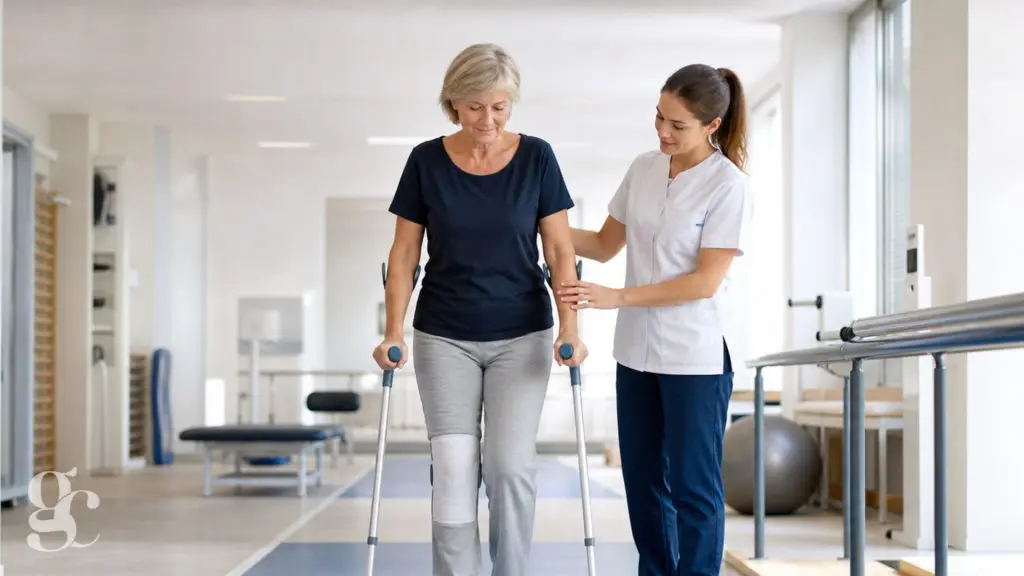
After knee replacement surgery, the written instructions from the surgical team take precedence over any schedule found online. Weight-bearing, walking assistance, scar care, and rehabilitation depend on the procedure performed, your condition, and any events that occurred during the operation. A satisfactory recovery does not automatically preclude the need for restrictions.
This guide provides guidelines for recovery after primary total hip replacement. Revision surgery, fractures, reconstruction, or complications often alter the course of treatment. It does not replace the discharge prescription, follow-up with the surgeon, or assessment by a physiotherapist.
Why does recovery vary after knee replacement surgery?
Implant fixation, bone quality, muscle strength, pre-operative mobility, balance, and any associated medical conditions all influence recovery. Therefore, two patients who have undergone similar prosthesis surgery may receive different instructions. The terms "full weight-bearing," "partial weight-bearing," or "non-weight-bearing" should be explained before discharge.
How to regain support and walking?
The first time getting up is learned with a caregiver. After that, move within the permitted limits, without turning distance into a performance goal. Safe walking is more important than the number of steps: proper foot placement, controlled turns, no swerving, and the ability to stop without losing balance.
When should you keep using walking sticks or a walker?
Do not discontinue use of crutches based on a date found elsewhere. Crutches remain useful after surgery until walking is deemed stable and conforms to the prescribed weight-bearing. The physiotherapist can check their adjustment, gait quality, and safety on stairs.
Advertising
Pain and swelling: what should you look out for?
Pain and swelling may accompany recovery. However, their trajectory is crucial: a decreasing discomfort is not the same as new, increasing, or recurring pain after an improvement. Note the context, weight-bearing capacity, and associated symptoms to describe them precisely to the team.
Is cold weather still appropriate?
A cold pack after surgery should only be used if specifically recommended, with a protective barrier between the skin and the cold source. Less sensitive, fragile, or poorly vascularized skin requires particular caution. Never apply cold directly to the scar, and do not follow a universal application time.
How to monitor the scar and the dressing
The type of closure determines the aftercare: absorbable sutures , removable sutures, adhesive, or surgical staples do not follow the same protocol. Follow the prescription regarding dressing changes and showering. Do not remove adhesive, scabs, or sutures, and do not apply any additional creams or antiseptics without prior authorization.
What changes need to be reported quickly?
Any redness that progresses, discharge, an opening, persistent bleeding, unusual pain, fever after the operation , or chills requires prompt contact with the medical team. A surgical site infection can sometimes be asymptomatic; therefore, the absence of fever alone is not sufficient to rule it out.
How to prevent phlebitis without improvising?
Prevention may involve authorized mobilization, anticoagulant therapy, and compression when prescribed. Never change the dose, frequency, or duration of medication on your own. Resuming walking does not automatically mean that treatment can be stopped.
Does calf pain necessarily indicate phlebitis?
No: symptoms alone are not sufficient for diagnosis. However, pain, warmth, or a significant increase in the size of one calf warrants urgent medical evaluation. Do not massage the calf or walk "to test" it. Consult our guide on the signs of phlebitis after surgery.
Advertising
What is the purpose of rehabilitation?
Rehabilitation encompasses several dimensions: pain, swelling, extension, flexion, quadriceps strength, balance, transfers, and gait safety. A mobility goal helps track progress but should not become a uniform standard imposed on everyone. Pushing too hard despite unusual pain can mask a problem instead of accelerating recovery.
When does a stiffness warrant reassessment?
Slow progress is not necessarily abnormal. However, marked stagnation, regression, sudden blockage, or loss of support should be reported. The surgeon will investigate the cause before adapting the treatment plan; there is no single exercise that is effective for all types of stiffness.
When should you call for help?
If you experience sudden or unusual shortness of breath , chest pain, coughing up blood, feeling unwell, losing consciousness, or bluish discoloration of the lips, call 15 (SAMU) in France, or 112 from any other European country, immediately. These signs may indicate a pulmonary embolism and should not wait for a scheduled appointment.
How to resume driving, work and sports?
Driving: verifying concrete skills
Resuming driving depends on alertness, medication, the operated leg, the type of vehicle, and the ability to get in and out of the vehicle, control the pedals, and perform emergency braking. Request medical clearance and check your insurance policy before driving after surgery.
Work: consider the position and the commute
Standing for long periods, climbing stairs, carrying loads, transportation, and workplace accommodations are just as important as the job title itself. A pre-return-to-work visit with the occupational health physician can help prepare for a gradual return or appropriate workplace adjustments.
Sport: observe the knee's reaction
Resume only permitted activities, gradually, taking into account your previous fitness level, strength, and balance. For swimming, the scar must be compatible with immersion, according to the team. A persistent increase in pain or swelling after activity warrants discussion with the healthcare professional overseeing your rehabilitation.
What should I prepare for returning home?
- The discharge letter, prescriptions, and contact information to call in case of problems.
- A clear explanation of the permitted support and walking aids.
- Instructions for dressing, showering and monitoring the scar.
- The treatment plan as prescribed.
- Follow-up and rehabilitation appointments.
Also, prepare the actual procedures, room by room, before the hospitalization. In the bathroom, check the route, the floor, any fixed supports, and the possibility of sitting down without improvising; the bathroom safety guide helps to identify these points. For the toilet, a raised toilet seat should only be used after checking the height, the toilet bowl, and the transfer procedure.
In the bedroom, keep documents, the telephone, permitted water, and everyday items within easy reach. A bed table or a reacher serves different purposes: neither should replace human assistance or circumvent a restriction in flexion or weight-bearing. Have the equipment and movement assessed before purchase, ideally with an occupational therapist or physiotherapist.
Commercial transparency: The image and button below are affiliate links and redirect to an exact gripping tool. GuideChirurgie may receive a commission without changing the price paid. It can only bring a light object closer from a stable position and after validation of the movement; it does not replace human assistance and should never be used as a support.
F.A.Q
How long does recovery take?
There is no single timeframe. Healing, independence, mobility, and resumption of activities do not all progress at the same pace. Use the goals set by the team rather than comparing yourself to another patient.
Is a hot and swollen knee always normal?
No. Context and progression matter. Increasing heat or swelling, associated with redness, new pain, a changed wound, fever, or chills, must be assessed.
Last editorial check: July 2026. No links in this article are affiliate links.
Advertising
Medical sources
- Health Insurance: Medical and surgical treatment of knee osteoarthritis
- Health Insurance: Living with knee osteoarthritis
- Health Insurance: Symptoms and diagnosis of phlebitis
- Health Insurance: Pulmonary embolism: recognizing the emergency
- French National Authority for Health: Thromboembolic events after total knee replacement
- French National Authority for Health: Infections after total knee replacement
- French National Authority for Health: Rehabilitation after total knee arthroplasty
- SOFCOT: Patient information sheet on total knee replacement
- Toulouse University Hospital: Patient booklet "My knee prosthesis"
- CRIOAc Lyon: Complex osteoarticular infection