This section was reviewed by Dr. Foued Hamza , a surgeon specializing in plastic, reconstructive, and aesthetic surgery. This section review falls within his area of expertise; articles are constantly evolving and not all are individually reviewed.
Disproportionately large, painful, or easily bruised arms may lead to a diagnosis of "arm lipedema." While this condition does exist, the volume, texture, or photograph of an arm alone cannot confirm it. The examination should primarily distinguish between a chronic distribution of adipose tissue and true swelling, and investigate other possible causes.
This section focuses on the upper limbs. For the general definition, the legs, and treatments, please consult our comprehensive guide to lipedema.
Does lipedema of the arms really exist?
Yes, clinical classifications describe possible involvement of the arms, sometimes associated with leg involvement. It can affect the upper arm and extend towards the forearm. The distribution is usually bilateral, but the symmetry is never perfect to the millimeter.
This location does not automatically mean that the disease is "advanced". The stages and types of lipedema describe a morphology; they do not, on their own, measure pain, disability, or progression.
What signs might indicate lipedema of the arms?
A similar distribution on both sides
A chronic and relatively symmetrical increase in subcutaneous tissue may guide the examination. A demarcation near the wrist is sometimes described, with the hands usually spared. However, none of these features is specific enough to establish the diagnosis on its own.
Pain, tenderness and bruising
Pain upon pressure, hypersensitivity, heaviness, and bruising after minor impacts are frequently reported. The impact can be tangible: uncomfortable sleeves, difficulty raising the arms, sleeping, or performing certain movements. The severity of these symptoms is not related to the diameter of the arm.
An irregular or "granular" texture may be described upon palpation, but this should not be considered a home test. Ordinary adiposity, loose skin, or other medical conditions can produce a similar sensation.
Sleeve length, arm circumference, or difficulty finding suitable clothing can indicate discomfort, but no threshold automatically separates a physical characteristic from a disease. Comparative photographs are also sensitive to posture, focus, and lighting. They can illustrate a specific change over time, but can never replace palpation, questioning, and examination of other limbs.
It is therefore more useful to describe what changes in daily life than to seek a perfect match with an online image.
Advertising
What does swelling of the hands or fingers mean?
Swelling of the hand and fingers is not the usual presentation of isolated lipedema. It may suggest lymphedema, an inflammatory, venous, or more general cause. It does not definitively rule out lipedema, as several conditions may coexist.
The appearance of a supposed "cuff" on the wrist therefore remains one indicator among others. Our comparison between lipedema and lymphedema explains why the hands, feet, and symmetry must be interpreted together.
What causes should be distinguished from lipedema of the arm?
Lymphedema of the upper limb
Lymphedema can affect the hand, be markedly asymmetrical, and appear after lymph node surgery, radiation therapy, or certain breast cancer treatments. The skin and volume can change over time, so the timing and medical history are essential.
Adiposity, lipohypertrophy and skin laxity
Painless fat deposits do not automatically meet the clinical criteria for lipedema. Weight fluctuations, sagging after weight loss, or a family history of arm shape can all affect the arms. Weight and response to diet are not diagnostic tests.
Acute or secondary causes
Trauma, infection, inflammatory reaction, medication, or venous damage can cause changes in the arm. A rapid onset, especially on one side only, follows a different pattern than a long-standing, symmetrical distribution.
How is lipedema of the arms diagnosed?
Useful information during the consultation
- the start date and the rate of change;
- the pain, sensitivity and circumstances of the bruises;
- the presence of similar signs on the legs;
- surgical, oncological, venous and lymphatic history;
- limited activities and treatments already tried.
Clinical examination and additional tests
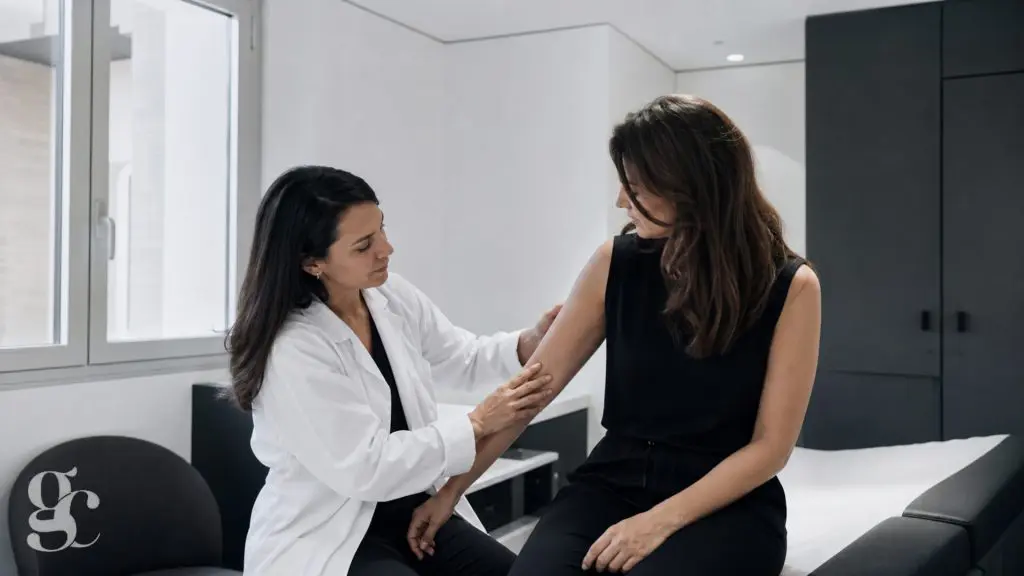
The doctor examines both arms, hands, and wrists, as well as the legs and trunk. They assess the skin, pain, mobility, and vascular signs. Reproducible measurements can aid in monitoring, but they do not serve as a universal threshold.
No single blood marker or imaging test can confirm lipedema of the arms. An ultrasound, Doppler ultrasound, or lymphatic drainage examination may be recommended to look for an associated or different condition. A definitive diagnosis based solely on photographs is insufficient.
Advertising
Can lipedema only affect the arms?
Classifications describe arm involvement, but data on a truly isolated form remain limited. When no signs are reported in the legs, a complete physical examination and differential diagnosis become particularly important. Both automatic "yes" and categorical exclusion should be avoided.
What should I prepare before the appointment?
Record the chronology, painful areas, circumstances of bruising, and medical history. Dated photographs can document changes, but they do not replace a physical examination. The page "Which doctor to see for lipedema" helps to understand the roles of the primary care physician and the vascular specialist.
To ensure you don't forget anything on the day of your appointment, also use our printable lipedema questionnaire to order the symptoms, the chronology and the useful questions without self-diagnosing.
Do not purchase a compression sleeve based on a clothing size and do not repeat painful tests. If compression is indicated, the prescription, the area covered, and the measurements must be individualized according to the principles described in our guide on lipedema compression garments.
When does a swollen arm require urgent evaluation?
Sudden swelling of one arm, redness, warmth, new pain, or fever requires prompt evaluation, particularly after surgery, cancer treatment, or the insertion of a venous catheter. Sudden shortness of breath, chest pain, dizziness, or loss of consciousness requires immediate medical attention, calling 15 (SAMU) in France, or 112 from any other European country.
Advertising
F.A.Q
Does lipedema affect the hands?
They are usually spared. Their swelling leads to the search for an associated or different condition rather than drawing a conclusion based on a single sign.
Can an ultrasound confirm the diagnosis?
No. It can document tissues or contribute to differential diagnosis, but it does not constitute isolated evidence of lipedema.
Is one arm larger than the other typical?
Slight asymmetry exists in many people. A new or marked difference is less typical and warrants examination, especially if accompanied by pain or swelling.