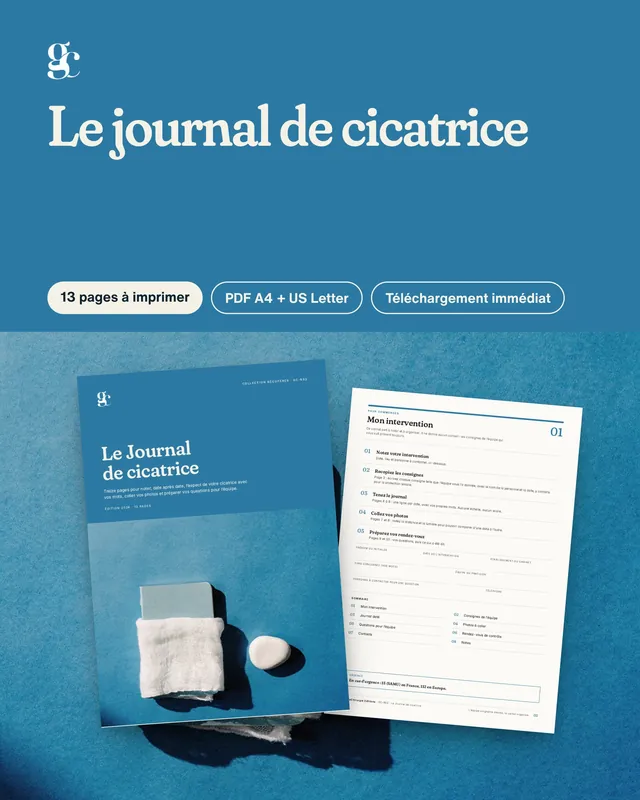
A lipedema diary is a simple tool: a few lines written over several weeks to bring facts to your appointment rather than impressions. It does not provide a diagnosis and does not replace a doctor's examination or measurements taken in the office. It helps to describe pain, heaviness, or changes in volume that vary depending on the time of day, heat, or fatigue.
Emergency: If a leg suddenly becomes red, hot, and swollen on one side, or if you experience difficulty breathing or chest pain, immediately call 15 (SAMU) in France, or 112 from any European country. Do not drive yourself.
Quick answer
A good journal consists of three columns: what you feel, what preceded it, and what you did. Note the pain on a simple scale of zero to ten, the feeling of heaviness, any bruising, and the circumstances. Circumference measurements, if your doctor deems them necessary, are always taken in the same way. The doctor interprets; the journal provides the data.
| Note | Why are | How does |
|---|---|---|
| Pain and sensitivity | The doctor can rate it on a scale of zero to ten | One note and one word per day |
| Heaviness, swelling | It varies throughout the day and with the heat. | Morning and evening, in a few words |
| blue | These are among the symptoms described. | Date and presumed cause |
| Mesures | The doctor measures the circumferences himself. | Only if you are asked |
What is the purpose of a lipedema diary?
According to the French National Health Insurance (Assurance Maladie), the diagnosis of lipedema is based on a clinical examination, the patient's medical history, and her symptoms. The doctor may assess the pain on a scale of zero to ten and takes measurements: waist, hips, thighs, and legs. However, a consultation is brief, and sensations vary from day to day. A journal bridges the gap between what you experience and what you can describe in just a few minutes.
The French National Health Insurance (Assurance Maladie) describes common symptoms as those worth monitoring: heavy, tense, painful, or tender legs; limb fatigue that worsens at the end of the day; discomfort exacerbated by heat; and bruising from minor bumps. The British National Health Service (NHS) similarly mentions pain, tenderness, heaviness, and a tendency to bruise easily.
Lipedema diary: what to record each day?
Pain and sensitivity
Assign a score from zero to ten, then add a word: pulling, dull, to the touch, to the weight of the garment. Specify the area. Avoid comparing from one week to the next without a reference point: it's the same scale, rated by the same person, that makes the reading useful.
The heaviness, the heat, and the fatigue
Note the time of day, the ambient temperature, whether you've been sitting or standing for long periods, and your level of fatigue. The French National Health Insurance (Assurance Maladie) indicates that these pains are not relieved by elevating your legs and are aggravated by heat: the context is just as important as the intensity.
Bruises and skin
Record the date of any bruising, its location, and any impact. Also note any skin that is warm, red, or noticeably different from one side to the other: this sign should not be expected at the next consultation. See below for cases requiring prompt attention.
Advertising
Should you measure your legs at home?
Not by default. Circumference measurements are taken by your doctor or healthcare professional using a specific method. Measurements taken at home with a flexible measuring tape vary depending on position, tape tension, time of day, and hydration: they can cause unnecessary worry or false reassurance.
If your doctor asks you to track your measurements, ask them to show you the reference points. Always take them in the same place, at the same time of day, standing or sitting in the same position, and note the time. Don't try to reach a specific number: a difference only makes sense when discussed with your doctor.
How to present the newspaper for consultation?
- Bring a summary page rather than the whole notebook: the three or four elements that come up most often.
- Specify how long the symptoms have existed and what modifies them.
- Note any ongoing treatments, compression (if any) and usual activities.
- Write down three questions to ask, in order of importance.
The consultation preparation questionnaire complements the diary: one describes your daily life, the other structures the discussion with the doctor. To find out who to contact, see which doctor to consult for lipedema.
The French National Authority for Health (HAS) promotes shared decision-making between patients and healthcare professionals. A patient diary supports this approach: it provides the doctor with concrete information about your daily life and allows you to set your priorities, such as relieving pain, better tolerating heat, or understanding compression options, before discussing the next steps.
What the newspaper does not allow
It does not confirm a stage, does not distinguish lipedema from lymphedema, and does not measure the effect of a treatment on its own. The guide on the stages and types of lipedema explains why the diagnosis remains clinical, and the one on the differences with lymphedema explains why a professional opinion is essential. The French National Authority for Health (HAS) also dedicates a page to primary lymphedema, another cause of chronic limb swelling.
It should also not become a source of guilt. The French National Health Insurance (Assurance Maladie) reminds us that these symptoms are not improved by calorie restriction: a journal is for understanding, not for judging oneself.
Advertising
When should you not wait for the next consultation?
A leg that suddenly becomes red, hot, very painful, or swollen on one side, a wound that becomes infected, a fever, or new shortness of breath cannot be treated with a newspaper. Contact a doctor immediately, and call 15 (SAMU) in France, or 112, in case of difficulty breathing or chest pain.
F.A.Q
How long should I keep the journal?
A few weeks are often enough to identify trends, but the doctor will determine the appropriate timeframe for their assessment. Ask about it before starting.
Paper or app?
The medium doesn't matter. Choose the one you'll actually use and that you can show without exposing other personal data.
Can we attach photos?
Ask the doctor if they wish to do this and under what conditions. Photographs of your skin are part of your health data: maintain control over them.
Advertising
Institutional sources
- Health insurance, lipedema: symptoms and diagnosis, accessed on October 9, 2026.
- Health insurance, treatment of lipedema, accessed on October 9, 2026.
- NHS, lipedema, accessed on October 9, 2026.
- French National Authority for Health, primary lymphedema, accessed on October 9, 2026.
- High Authority for Health, patients and healthcare professionals: deciding together, accessed on October 9, 2026.
Editorial note: This article was written on October 9, 2026, using institutional sources consulted on that date. It provides information without offering a diagnosis or replacing the advice of your healthcare team. Internal reference: lipoedeme-journal-20261009.