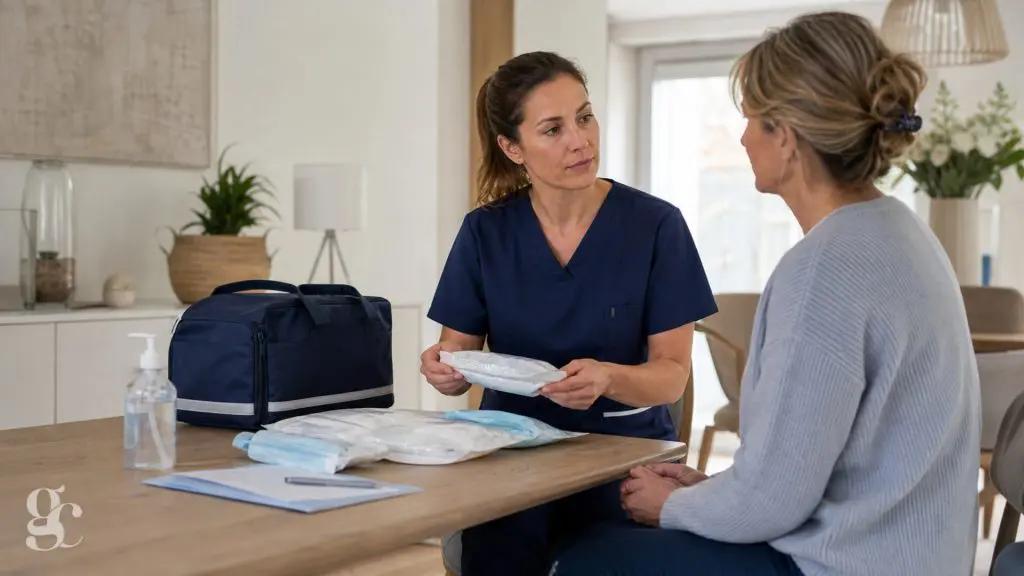
A home nurse after surgery can provide prescribed care, monitor the wound's progress, and alert the medical team. This organization cannot be improvised the evening of the patient's return: it relies on a legible prescription, a discharge protocol, the necessary equipment, and the contact information for the relevant service.
Not all surgical wounds require the same follow-up care. Some dressing changes can be performed by a professional; in other situations, the department may recommend a different approach. Do not choose the frequency, product, or discontinuation date of the dressing yourself. The post-operative dressing guide explains the main guidelines but does not replace the prescription.
Home nurse after surgery: preparing care before discharge
Ask the department to confirm in writing what needs to be done at home. The discharge summary and prescription should allow the healthcare professional to understand the expected care, its start date, duration, and conditions for reassessment, as well as any relevant details. Also, check who monitors the scar between appointments and which number to call in the evening or on weekends.
- nursing care order and, if necessary, equipment order;
- service protocol or report useful for monitoring;
- date of the next surgical check-up;
- instructions for the shower, drains, wires or staples;
- contact details of the service and procedures to follow in case of an alert;
- Support documents and supplementary health insurance card.
Any ambiguous information must be clarified with the prescribing physician before the first procedure. The nurse cannot deduce the expected protocol based solely on the type of procedure. The home discharge checklist helps prepare these documents along with other practical needs.
Advertising
Who can arrange a home visit?
The hospital physician or the attending physician can prescribe nursing care when the situation warrants it. The public portal dedicated to autonomy outlines several options: private nurse, nursing health center, home-based autonomy service (SSIAD) for individuals who meet the criteria, and home hospitalization for more complex and coordinated care.
These solutions are not interchangeable. A one-off visit for a simple wound requires a different approach than care involving multiple treatments, dependency, or complex dressings. The hospital team, the attending physician, or social services can refer the patient to the appropriate facility.
How can I find an available nurse?
Begin making calls before the scheduled procedure or as soon as the discharge date is known. Use the national health insurance directory, the contact information provided by the facility, or a nursing health center. Specify the sector, the desired start date, the general nature of the care, and whether a prescription exists, without spontaneously sending medical data through an unsecured channel.
- Does the firm operate in your neighborhood and at your address?
- Can the treatment be done at home or do I need to go to the clinic?
- What documents must be available for the first visit?
- Does the professional ask that the equipment be collected from the pharmacy before their arrival?
- How to contact the office in case of a change in prescription or delayed discharge?
If no healthcare professional is available, contact the service that arranged your discharge, your primary care physician, or the facility indicated on your documents. Do not wait until the dressing is saturated or the wound becomes painful to report the lack of follow-up care.
What the nurse checks around the wound
The care process is not limited to simply removing and replacing a dressing. Depending on the prescription and the situation, the nurse observes the appearance of the wound and the surrounding skin, the drainage, the condition of the dressing, the reported pain, and the overall progress. She may document her observations, explain the precautions, and contact the prescribing physician if the treatment strategy needs to be reassessed.
The French National Authority for Health (HAS) reiterates that, for a sutured surgical wound, the choice of dressing depends in particular on the location, tension, and identified risks. It also emphasizes that practices can vary and that certain situations require adaptation. This variability precludes applying a schedule found online as if it were applicable to all operations.
Advertising
How often should the dressing be changed?
There is no universal frequency for dressing changes. It depends on the type of closure, the dressing itself, the drainage, the location, the protocol, and the observed progress. The frequency prescribed or determined by the healthcare professional may be revised if the wound changes. Do not perform frequent dressing changes "to clean more" and do not prolong the use of a dressing that has become unnecessary.
Conversely, a dressing that comes loose, leaks, becomes wet, or is saturated should not simply be left until the next scheduled visit. Follow the written instructions or contact the office and the department. A surgical wound that reopens requires evaluation, not just re-dressing.
Prepare the equipment without choosing the treatment
Have your prescriptions checked before leaving the facility or at the pharmacy. The product codes, dimensions, and quantities must correspond to the intended treatment. Do not purchase a complex dressing, antiseptic, or "healing" product simply because it appears more technical. The healthcare professional will choose or clarify the treatment strategy based on the wound.
Nurses have limited prescribing rights for certain medical devices under certain conditions. This does not mean that any product can be substituted without consulting a doctor. In case of a shortage, known allergy, unsuitable format, or unclear prescription, ask the pharmacist and nurse to coordinate the clarification.
Organize a clean and accessible space
Ensure the room is clear, well-lit, and has access to a sink for hand hygiene, without turning it into a medical supply room. Remove animals, smoke, food, and personal belongings during the visit. Keep equipment in its packaging, dry, and according to the specified conditions.
The nurse must be able to reach the area without putting themselves or the patient in a position that could be dangerous. Inform the nurse in advance of any stairs, a malfunctioning intercom, severely limited mobility, or the presence of any special equipment. Do not get up without the assistance provided, except to open the door.
Advertising
Home care and reimbursement: what you need to check
A prescription alone does not guarantee full reimbursement. Coverage depends on the procedure performed, its compliance with national health insurance regulations, the patient's situation, the location of the treatment, any travel expenses, and supplemental insurance coverage. Some facilities also have their own admission requirements.
Before your first appointment, ask the clinic if they accept direct billing, what documents to bring, and if there might be any out-of-pocket expenses or uncovered costs. For a personalized answer, contact your health insurance provider and supplemental insurer using the actual prescription. GuideChirurgie cannot confirm the reimbursement amount remotely.
Threads, staples and removal: do not anticipate the date
The presence of absorbable sutures does not eliminate the need for monitoring, and surgical staples should only be removed according to the prescription and schedule appropriate for the wound. Never attempt to cut a suture, remove a staple, or peel off a scab simply because an average date has passed.
Signs to pass on without waiting for the next passage
- pain that increases or changes;
- spreading redness, increasing heat or swelling;
- new, abundant, cloudy or foul-smelling discharge;
- bleeding that quickly soaks through the dressing;
- opening of the edges, skin that darkens or blisters;
- fever, chills, malaise or general deterioration of condition.
These signs do not all prove infection, but they do warrant medical attention. The guide on signs of infection in a surgical wound can help you prepare for the call. In case of significant bleeding, severe discomfort, difficulty breathing, or a sudden worsening of symptoms, call 15 (SAMU) in France, or 112 from any European country.
Useful questions to ask during the first pass
- What should be observed between two treatments?
- What should I do if the bandage gets wet, comes off or leaks?
- Who should I contact first: a clinic, a service, or my primary care physician?
- Is showering allowed and with what protection?
- When should the prescription or protocol be reassessed?
- What documents should be kept for tracking and invoicing?
Record your answers in a notebook or the calendar provided by the team. A photo of the wound should only be taken and sent according to the procedures agreed upon with the healthcare professional. Personal messaging and social media are not a medical record.
Verified sources
- National information portal for older people: Organizing home care
- French National Authority for Health: Dressings for sutured wounds after surgery
- Health Insurance: Prescription of nursing care
- Health Insurance: Medical devices that a nurse can prescribe
- Health Insurance: Complex dressings by prescription
Editorial note: This is a general information article verified on July 23, 2026. The prescription, the facility's protocol, and the professional's assessment take precedence. This article does not guarantee home intervention or a specific level of reimbursement.