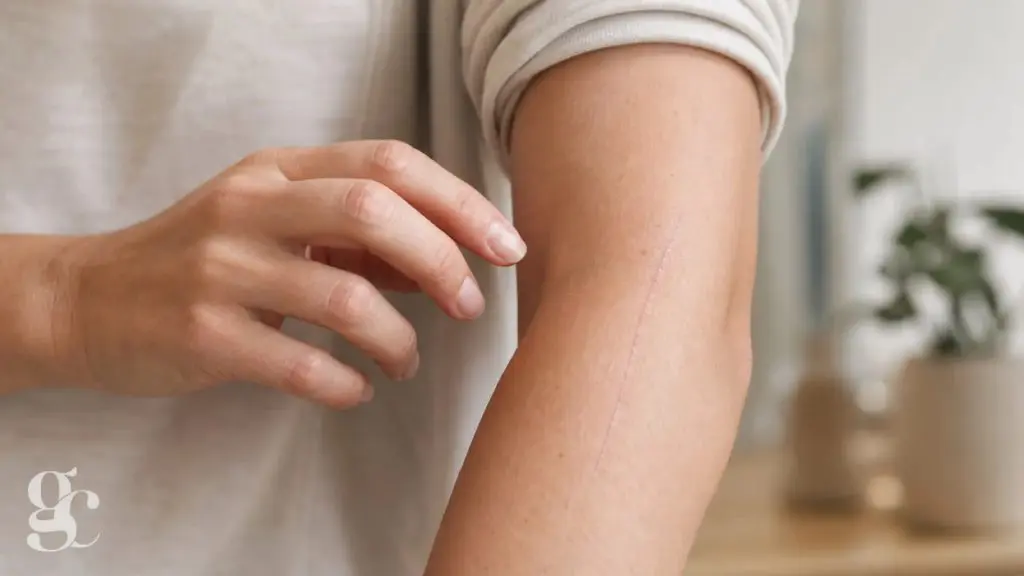
An itchy scar after surgery doesn't automatically indicate a complication. The healing skin may be dry, sensitive, or have unusual sensations. But itching alone doesn't guarantee that everything is progressing normally.
The key indicator is the progression: the appearance of the wound, the intensity of the discomfort, associated symptoms, and instructions specific to the procedure. For daily care, the protocol provided by the department and our post-operative dressing guide remain the primary resources.
Quick answer
An itchy scar doesn't automatically indicate a complication, but itching alone doesn't guarantee that everything is progressing normally. Contact the team the same day if the wound changes or if the discomfort becomes intense and persistent. Facial swelling or difficulty breathing: call 15 (SAMU) in France, or 112 in Europe. Source: French National Health Insurance.
Itchy scar after surgery: why?
The skin repairs and remodels itself
After the incision closes, the tissues continue to change. The scar may be firmer, more discolored, dry, sensitive, or itchy, and then gradually change over time. The Royal National Orthopaedic Hospital reminds us that a developing scar may itch and remain sensitive, without establishing a universal timeline.
Nerve sensations can change
An incision cuts through tiny nerve endings. During recovery, some people describe tingling, numbness, hypersensitivity, or a pulling sensation, in addition to the urge to scratch. Burning pain, shooting pains, a spreading loss of sensation, or functional impairment should be described to the team rather than automatically categorized as part of the healing process.
Advertising
Which elements are more compatible with a simple evolution?
Mild, intermittent itching, without worsening pain, spreading redness, significant heat, discharge, or opening, may accompany the healing of a wound. It is more reassuring if the patient's overall condition improves and if the appearance remains consistent with the service's explanation.
These criteria are not a substitute for an examination. A photograph does not show heat, odor, or depth. The location and the procedure alter the interpretation. The article on scars after abdominoplasty illustrates this variability.
Wound or scar: an essential distinction
An area that is still open remains a problem.
If the edges are not closed, if a scab persists, if the area is oozing, or if a thread, staple, glue, or drain is still present, do not treat it like a mature scar. Massage or product advice intended for completely healed skin does not apply.
A visible closure is not always enough
An incision may appear closed while the underlying tissues remain fragile. The point at which a product, massage, immersion, or activity becomes possible again depends on the procedure. The guide dedicated to swimming after surgery explains why outward appearance is not a guarantee of approval.
What associated signs should prompt the team to contact them?
- A redness that is progressing or a noticeably warmer area.
- A new pain, increasing or different from that described upon discharge.
- A tense, asymmetrical or increasing swelling.
- A cloudy, colored, abundant, or foul-smelling discharge.
- Edges that pull apart, a blister, skin that darkens, or unusual bleeding.
- Chills, discomfort, a moderate fever, or a deteriorating recovery.
Itching is just one factor among many. It shouldn't delay the call simply because it's considered "normal." Conversely, a normal temperature isn't enough to rule out a local problem. Note any changes and use the number from the discharge summary.

Advertising
What if the bandage or product irritates the skin?
An adhesive, glue, antiseptic, textile, or product applied around the wound can cause irritation or a contact reaction. The area may itch, redden, or show small lesions, sometimes depending on the shape of the adhesive. However, this appearance does not rule out a distant infection.
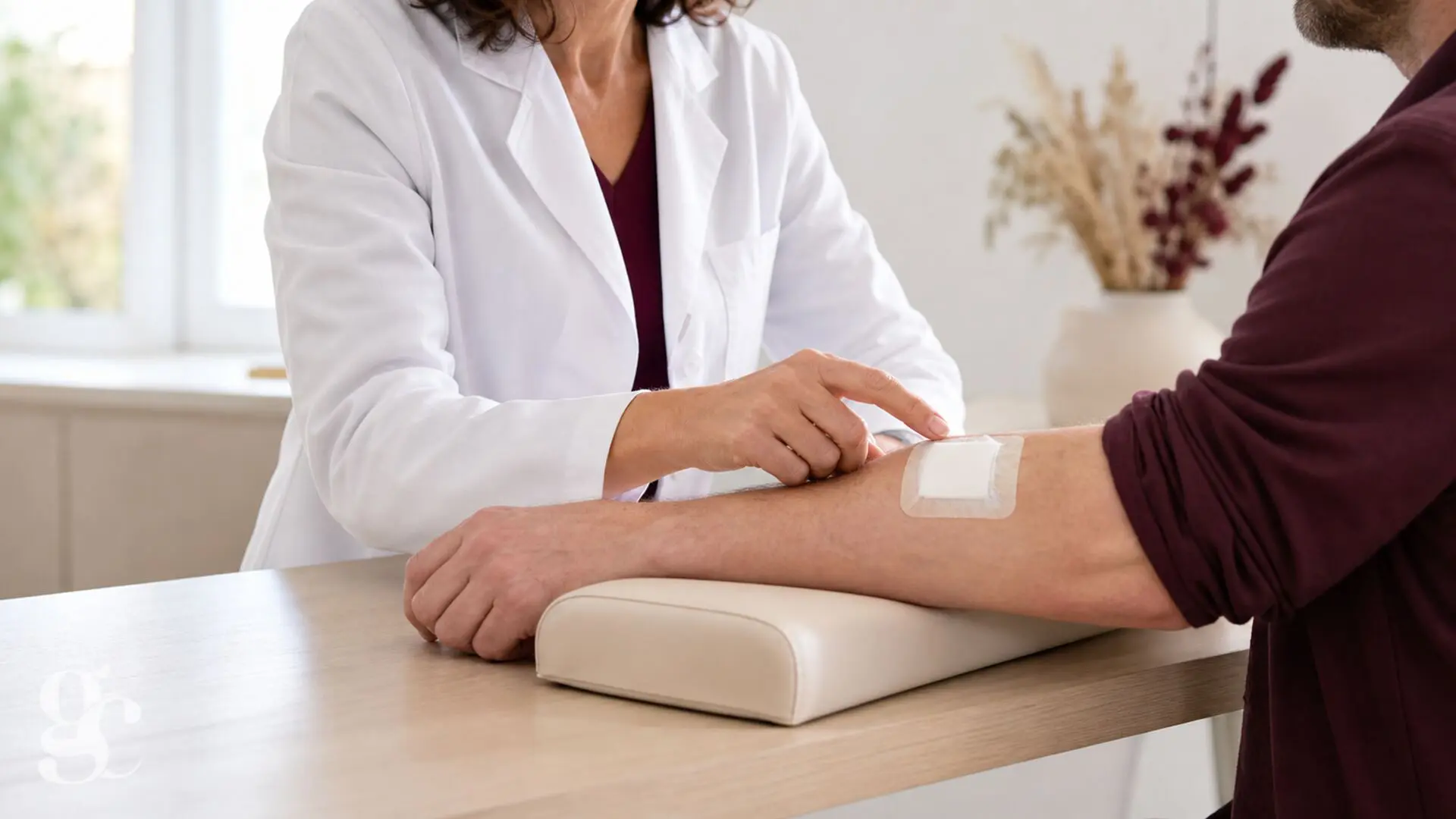
Do not abruptly remove any device that the team has asked you to keep in place. Photograph the area if it is helpful, note the name of the product, and ask how to protect the wound. Also report any itching that develops after starting a new medication, especially if it becomes widespread.
What actions should be avoided?
Do not scratch, pierce or tear
Fingernails can damage the skin, loosen glue, tear off a scab, or introduce germs. Do not pop a blister, cut a protruding thread, or squeeze the area to find fluid. Instead, minimize friction from clothing and keep nails short if scratching occurs while sleeping.
Do not use too many products
Avoid essential oils, homemade preparations, leftover creams, or unsolicited antiseptics. These can irritate, macerate, or alter the appearance of the area. Also, do not take any anti-itch medication without first checking its compatibility with post-operative treatments with a doctor or pharmacist.
How can we seek relief without masking a problem?
Until the wound is completely closed, follow only the written instructions. Avoid excessive heat, prolonged sweating, and clothing that rubs against the wound. If the dressing is uncomfortable, ask the staff if it needs to be checked or changed instead of applying a dressing underneath.
Once the skin has fully healed, the team can authorize simple moisturizing or teach a suitable massage technique. Studies on physical scar treatments encompass a wide variety of methods; they do not define a single approach for all incisions. Massage should never be improvised on a painful, inflamed, or fragile area.
Silicone sheets or gels are sometimes discussed for certain closed scars, but they are not a guaranteed treatment for all itching. The choice depends on the surface of the wound, individual tolerance, and risk. Irritation warrants discontinuing the trial and seeking advice.
Transparency: The image and button below are affiliate links and redirect to the exact same product page. GuideChirurgie may receive a commission without changing the price paid. This product is only for the photoprotection of fully closed and exposed skin, never for the direct treatment of itching or a still-fragile wound.
When should you request a quick or urgent opinion?
Contact the service quickly
Contact the team the same day if the wound changes, if the itching becomes intense and persistent, if it prevents you from sleeping, if a product seems to have triggered a reaction, or if a scar becomes increasingly thick and painful. Any pain that changes deserves a precise description; our guide to post-operative pain will help prepare you for the consultation.
Call emergency services if their general condition deteriorates.
Call 15 (SAMU) in France, or 112 from any European country, if you experience significant difficulty breathing, facial or throat swelling, fainting, confusion, chest pain, or rapid deterioration. A widespread reaction with respiratory distress after taking medication or using a product requires more than simply monitoring a scar.
How to prepare for the call or consultation?
- Please specify the procedure and its date.
- Indicate when the itching started and how it is progressing.
- Describe redness, heat, pain, swelling, discharge, and general condition.
- List the dressings, products and medications recently used.
- Report any implants, drains, wires, or staples that are still present.
Dated photographs taken under comparable conditions can supplement this timeline if the team requests them through an appropriate channel. The return-home checklist also allows for the collection of contact information, documents, and instructions without recording any health data.
Advertising
Is it normal for a scar to remain thick and itchy for a long time?
A hypertrophic scar remains raised within the boundaries of the incision; a keloid may extend beyond them. Both can itch, but a red, firm, or tender scar does not necessarily belong to one of these categories.
A surgeon or dermatologist can examine the texture, mobility, color, and impact of the scar before discussing treatment options. Healing can be a lengthy and non-linear process. No product can make a scar invisible, and the objective must be clearly defined: comfort, flexibility, mobility, or appearance.
F.A.Q
Does an itchy scar mean it's healing well?
Not necessarily. Itching can accompany the healing process, but it doesn't prove proper closure or the absence of infection. The appearance, progression, and associated symptoms are more important.
Can I apply cream immediately?
Not without instructions. A cream intended for a closed scar should not be applied to an open wound, under a dressing or near a device without the team's agreement.
Can swelling cause pulling sensations?
Yes, but its cause and severity depend on the location and associated symptoms. Sudden, painful, or asymmetrical swelling should be reported. The information sheet on postoperative edema provides further guidance.
Verified sources
- Royal National Orthopaedic Hospital, scar care after surgery
- NHS, scars: evolution and general care
- NICE, prevention and treatment of surgical site infections
- Centers for Disease Control and Prevention, surgical site infection
- Health insurance: what to do if you have itching
- French National Authority for Health, dressings for sutured surgical wounds
- Systematic review, physical treatments of scars and associated symptoms
Editorial note: General information article verified on July 16, 2026. It does not allow for the evaluation of a wound remotely and does not replace discharge instructions or examination by the healthcare team.