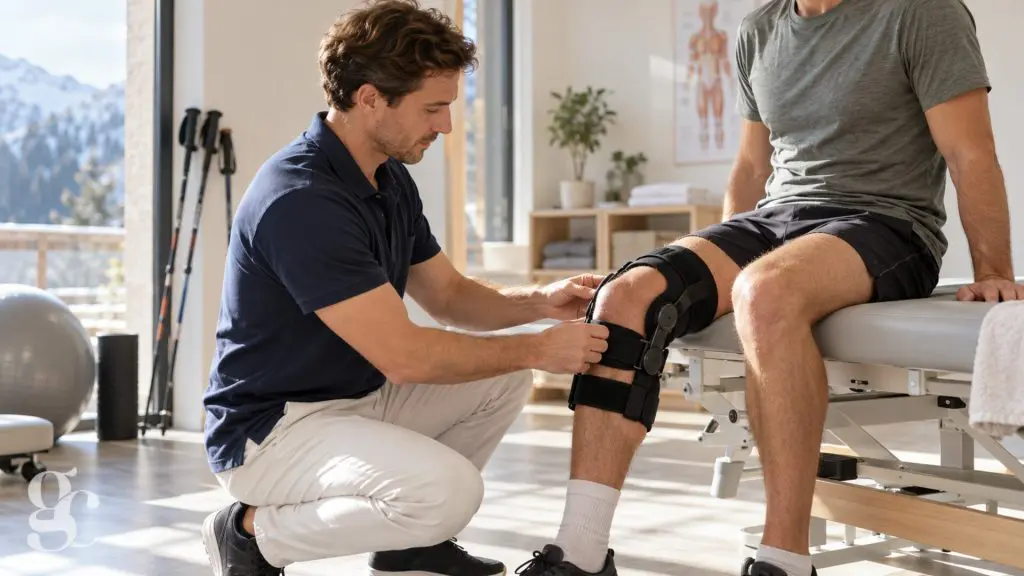
Choosing a knee brace after a sprain isn't a matter of chance: knee pads, hinged braces, and immobilizing braces are designed for different levels of severity. The French National Health Insurance (Assurance Maladie) advises against completely immobilizing the knee for mild to moderate sprains: maintain weight-bearing, get moving early, and support helps with recovery. Immobilizing braces are reserved for severe sprains and for short-term use. Here's how to recognize a sprain, when to consult a doctor, and which type of support is appropriate for each situation.
Quick answer
The severity depends on which ligaments are affected. An isolated injury to a lateral ligament is generally less serious; an injury to a cruciate ligament, most often the anterior one, is always serious because it makes the knee unstable, reminds the Health Insurance.
Pain doesn't necessarily indicate severity: it can be moderate in a severe sprain and intense in a mild one. Only an examination can determine the cause.
| Severity established by examination | Restraint according to Health Insurance | With what |
|---|---|---|
| Benign (stretch) | No immobilization; knee brace or hinged orthosis possible | Support maintained, early mobilization |
| Medium (partial tear) | No complete immobilization; knee brace or hinged orthosis | Rehabilitation if necessary |
| Serious (rupture) | Short-term immobilization splint | Rehabilitation started quickly, surgery sometimes |
Recognizing a knee sprain
A knee sprain is an injury to one or more of its four ligaments: the two lateral ligaments, medial and lateral, on the sides, and the two cruciate ligaments, anterior and posterior, in the center. It occurs after a direct impact or an abnormal movement of the leg, for example during sports.
The French National Health Insurance (Assurance Maladie) describes a cracking sound at the time of the accident, a sharp pain felt like a tearing sensation, a feeling that the knee gives way to the side and then springs back into place, a sensation of instability, and swelling. Limping or the inability to bear weight on the leg may also occur.
The first steps
- Stop the activity immediately: continuing may worsen the injury.
- Rest the knee, without putting weight on the injured leg.
- Cool it with ice wrapped in a cloth, never directly on the skin.
- Apply a bandage without tightening it too much, and elevate the leg if the knee swells.
These are the four rules of the RICE protocol: ice, rest, elevation, compression. See also the proper use of a cold pack.
When to consult
The French National Health Insurance (Assurance Maladie) advises consulting a doctor the same day if symptoms are worrying, particularly a feeling of instability or dislocation. If the discomfort is very mild, without instability, you can wait one to two days while applying the initial steps, then consult a doctor if the symptoms persist.
The diagnosis relies primarily on examination: the doctor looks for abnormal knee mobility, fluid buildup, or a hematoma along the ligaments. Further tests are mainly used to rule out a fracture or to determine whether surgery is necessary.
Knee brace: the three types
- The knee pad : a flexible support that reduces pain and facilitates the resumption of activities.
- The articulated orthosis : supports on the sides, which allow the knee to bend while limiting lateral movement. The French National Health Insurance (Assurance Maladie) lists it alongside a knee brace for mild to moderate sprains.
- The immobilizing splint It immobilizes the knee. It is only justified for a severe sprain, and for a short period, in order to avoid stiffness and loss of muscle strength.
Applying a cast is generally unnecessary, according to the Health Insurance.
Knee brace or hinged orthosis: two models to compare
A knee brace and an articulated orthosis sold in online pharmacies. These are examples that should be reviewed by a doctor, who will determine which type is suitable for your sprain.
The immobilizing splint, for a severe sprain
For a severe sprain, the doctor may order short-term immobilization, quickly followed by rehabilitation. He will determine the duration.
Rehabilitation and treatment
A mild sprain usually heals with medical treatment, without rehabilitation. A moderate sprain, and especially a severe sprain, requires physiotherapy sessions to regain mobility, muscle strength, and proper knee function, whether standing, jumping, or running.
The choice between medical treatment and surgery, specifically ligament reconstruction, depends on age, the sport played, knee instability, and any associated injuries. The NHS clarifies that not all anterior cruciate ligament (ACL) injuries require surgery, but it may be recommended for highly athletic individuals or those whose knee remains unstable despite physiotherapy. See our guide to recovery after ACL reconstruction.
Resuming activities
- Resume daily activities as soon as possible after a sprain of the medial collateral ligament; a knee brace or hinged orthosis may help.
- During treatment, avoid squatting and kneeling positions, jumping and twisting.
- Seek medical approval before resuming sports; physical preparation and wearing compression stockings can facilitate recovery after a severe, non-operated sprain.
Your doctor will coordinate your follow-up care and any necessary time off work, which will depend on your occupation and the severity of the sprain. If weight-bearing is painful, crutches may be helpful initially.
Emergency: If you experience a swollen and painful leg with sudden shortness of breath or chest pain, especially if your knee has been immobilized, call 15 (SAMU) in France or 112 from any other European country immediately. Do not drive yourself.
F.A.Q
I heard a cracking sound: is it necessarily serious?
A cracking sound is one of the signs of a sprain, but only an examination will determine the severity. Consult a doctor the same day if it is accompanied by a feeling of instability or dislocation.
Do you need a prescription for a knee brace?
Knee braces and orthotics are available without a prescription at pharmacies; however, treatment requires a prescription. The consultation is primarily used to determine which type of support is appropriate.
Can I wear a knee brace to resume skiing?
According to the French National Health Insurance (Assurance Maladie), compression therapy can facilitate a return to training, but only with a doctor's approval and after rehabilitation. It does not replace physical preparation or the recovery of muscle strength.
Institutional sources
- Health Insurance, Understanding knee sprains (July 7, 2026), accessed on October 23, 2026.
- Health Insurance, Symptoms and diagnosis of knee sprain (July 7, 2026), accessed on October 23, 2026.
- Health Insurance, Treatment of knee sprain (July 7, 2024), accessed on October 23, 2026.
- Health Insurance, Knee Sprain: Resumption of Activities (July 7, 2026), accessed on October 23, 2026.
- NHS, ACL (anterior cruciate ligament) surgery (review of July 17, 2025), accessed on October 23, 2026.
Editorial note: This article was written on October 23, 2026, using institutional sources consulted on that date. It provides information without offering a diagnosis or replacing the advice of your healthcare team. Internal reference: knee-brace-sprain-20261023.