A post-operative bra can provide support and comfort after certain breast surgeries, but it is neither mandatory nor the same for all. The recommendation depends on the procedure, the scar, the dressings, whether a drain was used, and, in the case of reconstruction, the technique employed.
Before purchasing, ask if the team requires a bra, what level of support they expect, and which areas should remain unsupported. After some autologous tissue reconstructions, inappropriate pressure may be contraindicated. The department's instructions always take precedence over a salesperson's description.
Is a post-operative bra always necessary?
No. Some teams recommend a flexible prosthesis after conservative surgery, a reduction, or an implant procedure. In other situations, they may advise waiting, wearing a specific device, or avoiding compression of a reconstructed area. The word "post-operative" on a label does not replace this decision.
Your needs may also change as swelling and healing progress. Do not make a temporary instruction a permanent rule, and do not replace a prescribed device without contacting the team. Our guide to easy-to-wear clothing after surgery will help you organize the rest of your dressing.
Why do the instructions differ depending on the intervention?
Conservative surgery, reduction or mammoplasty
A flexible support can be offered to limit uncomfortable movement, provided that the bandage and seams do not cross the wound. The position of the incisions varies: a model that is comfortable for one person may press in exactly the wrong place for another.
Implant reconstruction
The team can specify a type of support depending on the procedure. No commercially available bra guarantees implant positioning or prevents complications. Do not add any band, foam, or targeted compression without instructions.
Reconstruction by flap
When a breast is reconstructed using the patient's own tissue, the team closely monitors her circulation. They may advise against wearing a bra immediately or advise against applying pressure to certain areas. Any changes in color, temperature, or volume, or any increasing pain, should be reported without delay.
Advertising
Support and compression: what's the difference?
Support garments hold the breast in place and limit certain movements. Compression garments exert a more structured pressure and may require a specific prescription. Therefore, a firm garment is not automatically better. The information sheet on compression garments after surgery explains why the pressure and duration should not be chosen arbitrarily.
A compression garment that is too tight can leave marks on the skin, interfere with dressings, or exert pressure on specific areas. Conversely, a garment that is too loose can roll down and chafe. The correct fit is determined by following the instructions provided, examining the pressure points, and assessing comfort both at rest and during permitted movements.
What characteristics should be checked?
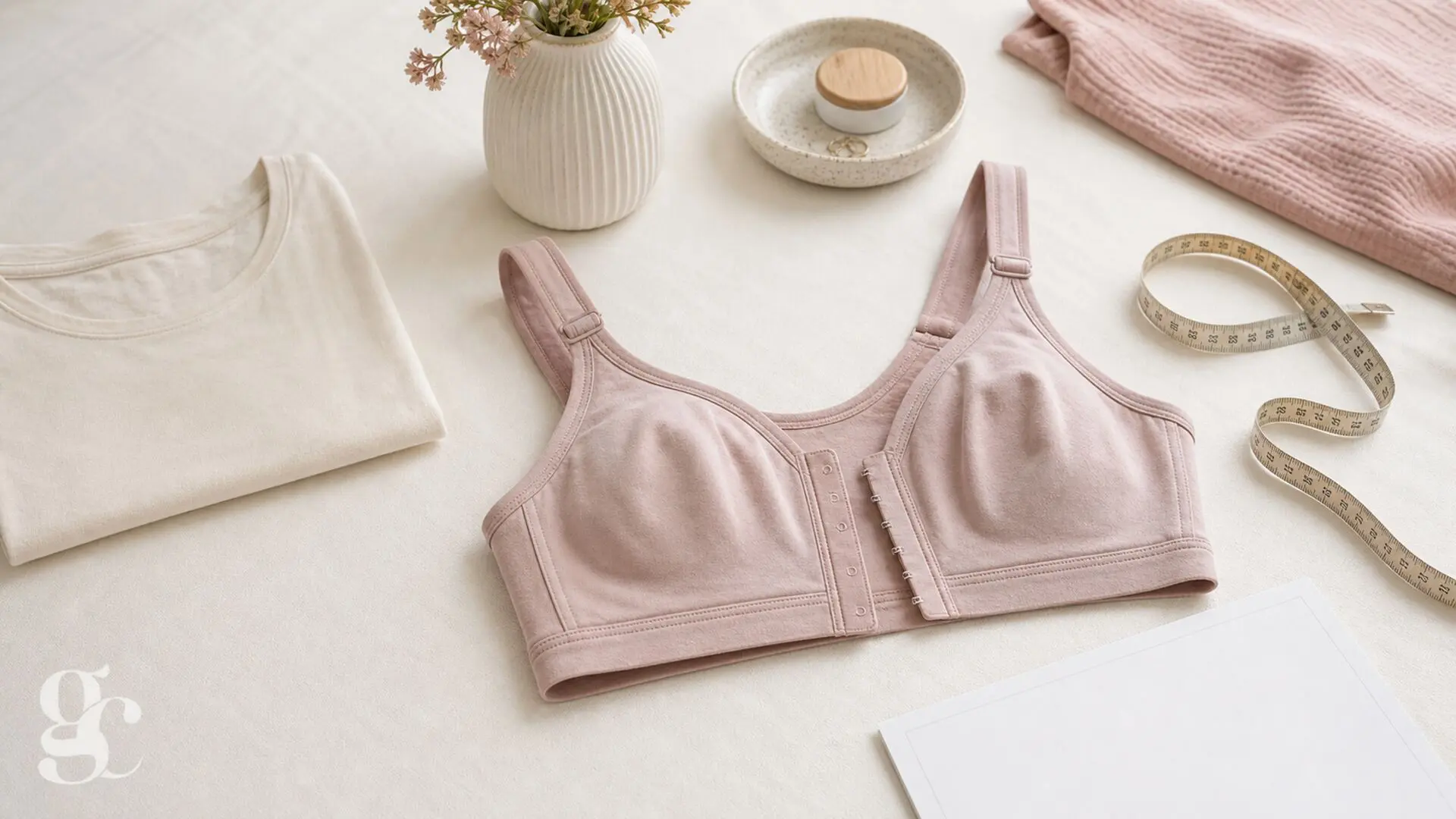
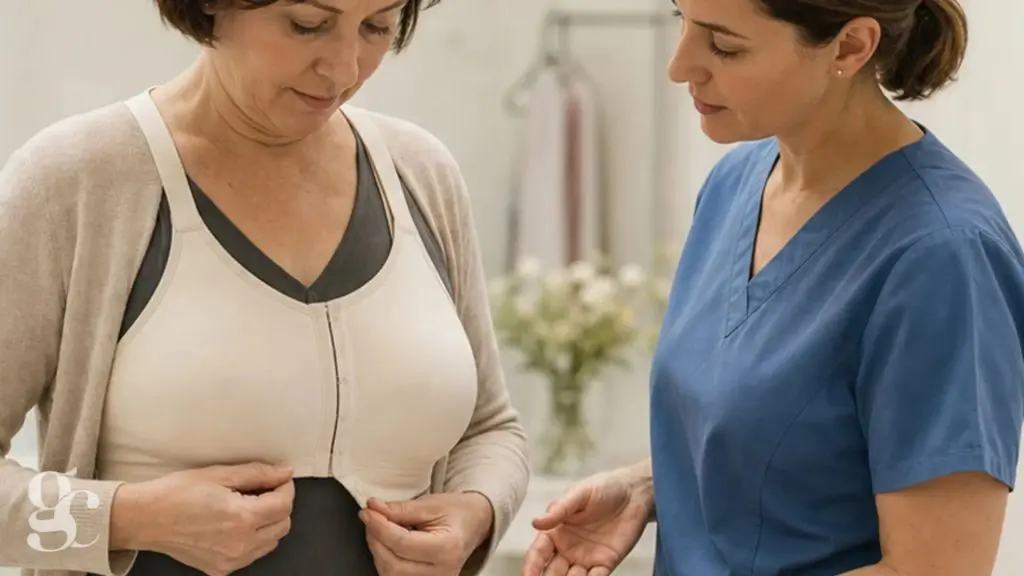
Frameless and front opening
A flexible, wire-free bra with a front opening is often easier to put on when arm movement is limited. This remains a practical criterion, not a medical requirement. The closure should be accessible without rubbing against the skin or creating a pressure point on an incision.
Seams, band and pressure areas
Run your hand along the seams and edges. The under-breast band should not roll, cut into the skin, or sit over the wound. Decreased sensation may be masking excessive pressure: examine the skin and ask someone for help if the area is difficult to see.
Dressings and drains
The bra must keep dressings in place and never pull, bend, or compress any tubing. If you are discharged with a drain, follow the instructions provided by the ward. Do not cut the garment or improvise a pocket if this will affect its support.
How to choose the size when considering swelling?
Your usual size may become unreliable due to swelling, dressings, and temporary asymmetry. Ask when and how measurements will be taken. If the team recommends a fitting, bring written instructions and point out any areas that should not be compressed.
- The cup accommodates the breast without crushing it or gaping excessively;
- the strip remains flat without leaving a deep mark;
- the closure does not pull and remains operable;
- The straps do not transfer all the tension;
- no stitches cross the wound or the dressing;
- The drains remain free according to the department's instructions.
Avoid buying multiple items before confirming the size and fit. Check the return policy before trying anything on. The home return checklist also helps you prepare a change of clothes and the service department's contact information.
Advertising
Validate the model with the team before purchase
If the team approves the purchase, confirm the type of support expected, the areas to be left free, the most practical opening, and the best time for a fitting. The right choice depends on the procedure, the dressings, and the evolution of the swelling, not on a marketing claim.
Bring the written instructions if a fitting is recommended. Then check, with a professional if needed, that the band, seams, and closure do not press on the scar, displace the dressings, or compress any area the department wishes to protect.
Transparency: The images and buttons below are affiliate links and redirect to the correct product page. GuideChirurgie may receive a commission without affecting the price you pay. This product features a front zip opening and a wire-free construction. This consumer model is not a medical device , and its marketing name "post-operative" does not guarantee its suitability for your specific procedure, dressings, or support needs.
Front zip opening: the zip may be easier for some people to grasp, but it adds a rigid area to control. Have its position confirmed in relation to the dressings and scar, then check the inner lining and return conditions before trying it on.
How to recognize excessive pressure?
A deep mark, a blister, broken skin, pain under the bandage, or numbness requires you to stop trying on the garment and seek advice. Do not assume that the garment has to be painful to be effective. If a device has been prescribed, contact the team before discontinuing it permanently.
Also watch for redness, warmth, swelling, or increasing pain, drainage, bleeding, an unusual odor, or an opening in the wound. The guide on suspected scar infection helps prepare information to share without making a diagnosis yourself.
When should you contact the team or call emergency services?
Contact the department immediately if a breast becomes rapidly enlarged, firm, or very asymmetrical; if the drain is pulled or compressed; if fever or chills develop; or if the color and temperature of a nipple or reconstructed breast change. After reconstruction, these changes should not wait until the next appointment.
Call 15 (SAMU) in France, or 112 from any European country, in case of difficulty breathing, chest pain, severe discomfort, or loss of consciousness. For daily monitoring, note any changes and refer to the post-surgery home recovery guide without delaying urgent contact.
Advertising
Questions to ask before ordering
- Do I need to wear a bra after my specific procedure?
- Is support or prescribed compression necessary?
- What incisions, dressings or tubing should be avoided?
- Is a front opening preferable given my permitted movements?
- How to check the size despite swelling?
- What signs indicate that the template should be removed and the service called?
Verified hospital sources
- Cambridge University Hospitals: Bra advice after oncoplastic surgery
- Cambridge University Hospitals: Advice after breast reconstruction
- Norfolk and Norwich University Hospitals: Return after flap reconstruction
- University Hospitals Plymouth: Mastectomy and implant reconstruction
- University Hospitals Plymouth: Therapeutic mammoplasty
- Cambridge University Hospitals: Returning home with a drain
Editorial note: General information article verified on July 17, 2026. It does not replace the instructions of the surgeon or the specialized nurse.