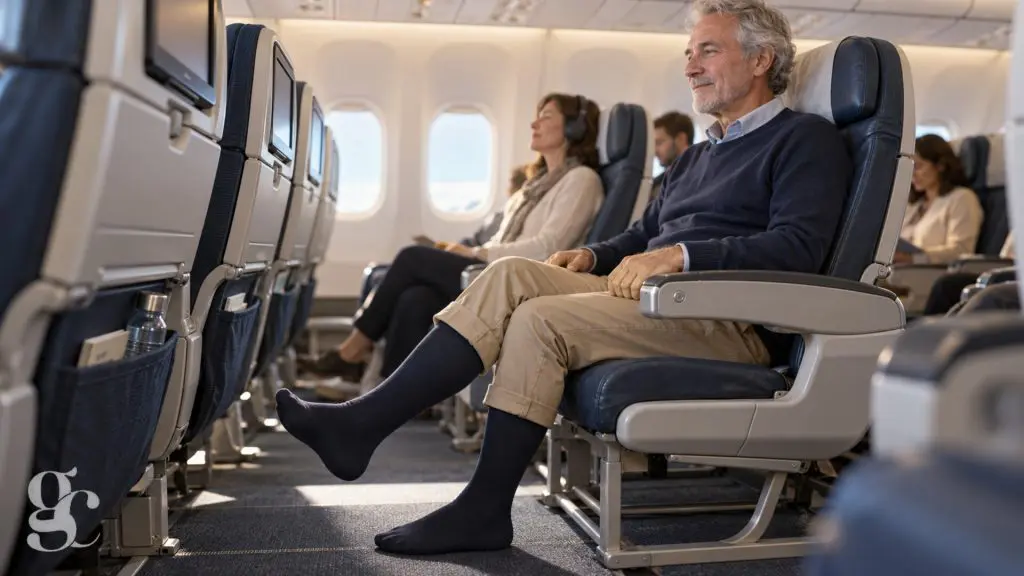
Compression socks on airplanes reduce the risk of deep vein thrombosis (DVT) during long flights, especially for people with risk factors. The French National Health Insurance (Assurance Maladie) reminds us that flights, particularly those exceeding four hours, increase the risk of DVT due to prolonged sitting, and recommends Class 2 compression stockings as soon as at least one risk factor is present. Here's who is affected, what studies show, how to choose and wear your stockings, and the onboard actions that are just as important.
Quick answer
Compression does not replace movement: moving your feet, walking in the corridor and drinking enough water remain essential, according to the Health Insurance and the NHS.
If you have a history of phlebitis or pulmonary embolism, have recently had surgery, are pregnant, or are undergoing cancer treatment, consult a doctor before leaving: the doctor will decide on compression and, sometimes, other measures.
| Your situation | What the Health Insurance recommends | Things to do |
|---|---|---|
| No risk factors | Actions on board: moving, walking, drinking, loose clothing | If in doubt, ask for advice. |
| At least one risk factor | Class 2 compression during transit | Medical advice before buying |
| History of venous problems | Consult before traveling | Meet before departure |
Why a long journey increases the risk of phlebitis
Sitting for several hours means the calf muscles, which pump blood back to the heart, are barely used. Blood stagnates in the leg veins, and a clot can form: this is deep vein thrombosis, or phlebitis. The French National Health Insurance (Assurance Maladie) mentions air travel, but specifies that its advice also applies to long car journeys; it also includes train travel among the long journeys where compression stockings can be used.
Who has a risk factor?
The Health Insurance system lists, in particular:
- a history of venous thrombosis or pulmonary embolism;
- a surgical operation lasting less than 4 weeks;
- pregnancy, estrogen-progestin contraception or hormone replacement therapy for menopause;
- cancer currently being treated, obesity, varicose veins, advanced age, smoking.
After an intervention, the question of travel arises with the team: whether to take a plane after an operation.
Advertising
Compression socks on airplanes: what studies show
The Cochrane review published in 2021 compiled trials conducted on air passengers. Its authors concluded, with a high level of certainty, that passengers wearing compression socks experienced significantly fewer asymptomatic deep vein thromboses and, with a lower level of certainty, less leg swelling. The trials were too small to measure the effect on pulmonary embolism or symptomatic deep vein thrombosis, as no cases occurred.
Choosing your socks
- the class : Health insurance recommends class 2 in the presence of at least one risk factor.
- Size The pharmacist measures your shoe size, ankle circumference, calf circumference, and height. The product must be perfectly suited to your legs.
- Medical opinion : even when sold over the counter, compression has contraindications, the main one being arteritis of the legs, which the doctor checks.
- Reimbursement : only on prescription, for a model listed in the list of reimbursable products.
The classes, measurements and reimbursement are detailed in our compression stockings guide.
Two Class 2 models for travel
A pair of women's and men's socks, both labeled as Class 2 by their manufacturer. These are examples that should be checked by a doctor or pharmacist to ensure they are the correct size.
Put them on and wear them during the journey
- Put them on the morning of departure, on dry skin without cream, turning the sock inside out up to the heel, without making any creases.
- Keep them on for the entire journey, and take them off in the evening.
If putting them on is difficult, a stocking aid can help.
Gestures on board, with or without socks
- Wear loose-fitting clothes; avoid girdles, tight belts and boots.
- Move your feet often, do ankle flexion and extension movements, do not cross your legs.
- Get up and walk around the corridor regularly; the NHS advises moving about every hour.
- Drink plenty of non-alcoholic beverages: the cabin air is drying.
- Avoid sleeping pills, which cause heavy sleep and prolonged immobility.
Warning signs, during or after the trip
The NHS describes stabbing pain in one calf or thigh, swelling in one leg, red or darker skin around the painful area, and swollen veins. These signs require prompt medical attention. See also the symptoms of phlebitis.
Emergency: sudden shortness of breath, chest pain, or coughing up blood, especially with a painful and swollen leg: immediately call 15 (SAMU) in France, or 112 from any European country. Do not drive yourself.
F.A.Q
From what journey duration?
Both the French National Health Insurance (Assurance Maladie) and the NHS cite journeys of more than 4 hours. Onboard safety measures remain useful regardless of the duration.
And by car or train?
The same advice applies: the French National Health Insurance (Assurance Maladie) extends it to long car journeys. Take breaks to walk.
I am pregnant, can I wear them?
Pregnancy is one of the risk factors mentioned. Talk to your midwife or doctor before traveling: they will choose the appropriate compression garment.
Institutional sources
- Health Insurance, Preventing Phlebitis (March 18, 2026), accessed on October 23, 2026.
- Health Insurance, How to use your compression socks, stockings or tights (October 14, 2025), accessed on October 23, 2026.
- Clarke MJ et al., Compression stockings for preventing deep vein thrombosis in airline passengers, Cochrane, 2021, accessed on October 23, 2026.
- NHS, Deep vein thrombosis (DVT) (reviewed April 30, 2026), accessed on October 23, 2026.
- French National Authority for Health, Medical compression in the prevention of venous thrombosis (best practices guide), accessed on October 23, 2026.
Editorial note: This article was written on October 23, 2026, using institutional sources consulted on that date. It provides information without offering a diagnosis or replacing the advice of your healthcare team. Internal reference: compression-socks-airplane-20261023.