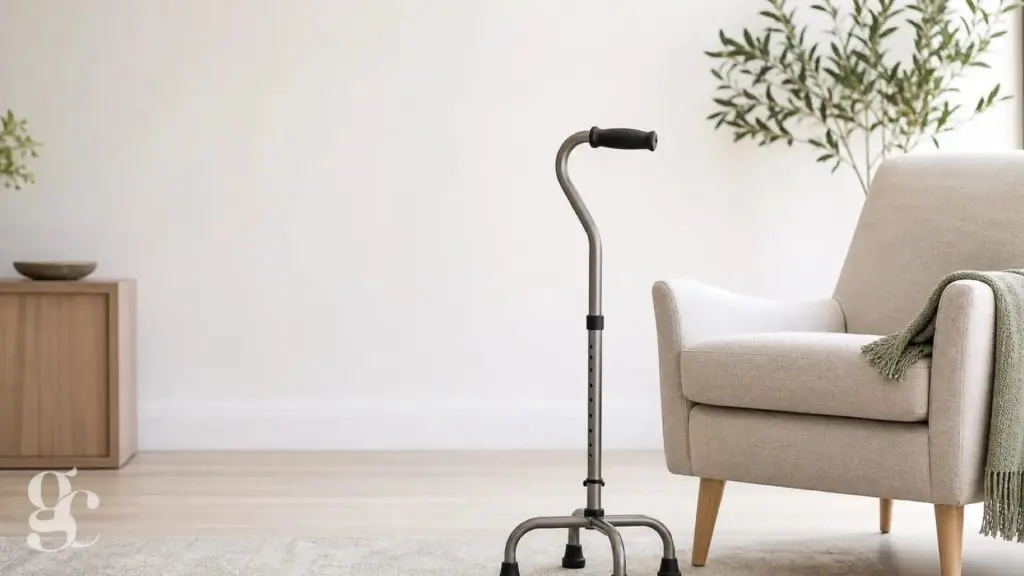
A four-legged walking stick, after surgery, can provide more ground contact than a simple walking stick thanks to its four-legged base. However, it is not automatically safer: a base that is too wide, poorly oriented, or only partially positioned can catch the foot and cause an unsteady gait.
Before purchasing a cane, ask your physiotherapist, occupational therapist, or discharge team if a cane is compatible with the weight-bearing limits you are allowed and your abilities. The decision to switch from crutches or a walker to a cane should not be based solely on pain reduction.
What is a four-legged walking stick after surgery?
The stem terminates in a base with four feet and four end caps. Depending on the model, the base is compact or wider, symmetrical or offset. Some devices can be configured for right- or left-handed use; others require no modification. The instruction manual allows you to verify this feature.
The four-legged cane remains a unilateral aid. It does not necessarily replace crutches after an operation when precise weight-bearing is required, nor a postoperative walker when two hands or a frame are necessary.
When to request a professional trial?
A trial is essential if you are unsure which limb can bear weight, if your balance has changed, if a hand or shoulder is painful, if you have fallen, or if you are hesitating between several aids. The professional observes your gait, turns, rising from a chair, and how the device performs on the actual floor.
He may conclude that a simple cane is sufficient, that a four-legged base obstructs the foot's passage, or that a frame offers more appropriate support. Equipment may change during post-surgery recovery at home , but each change warrants a reassessment.
Advertising
How to adjust the height without improvising?
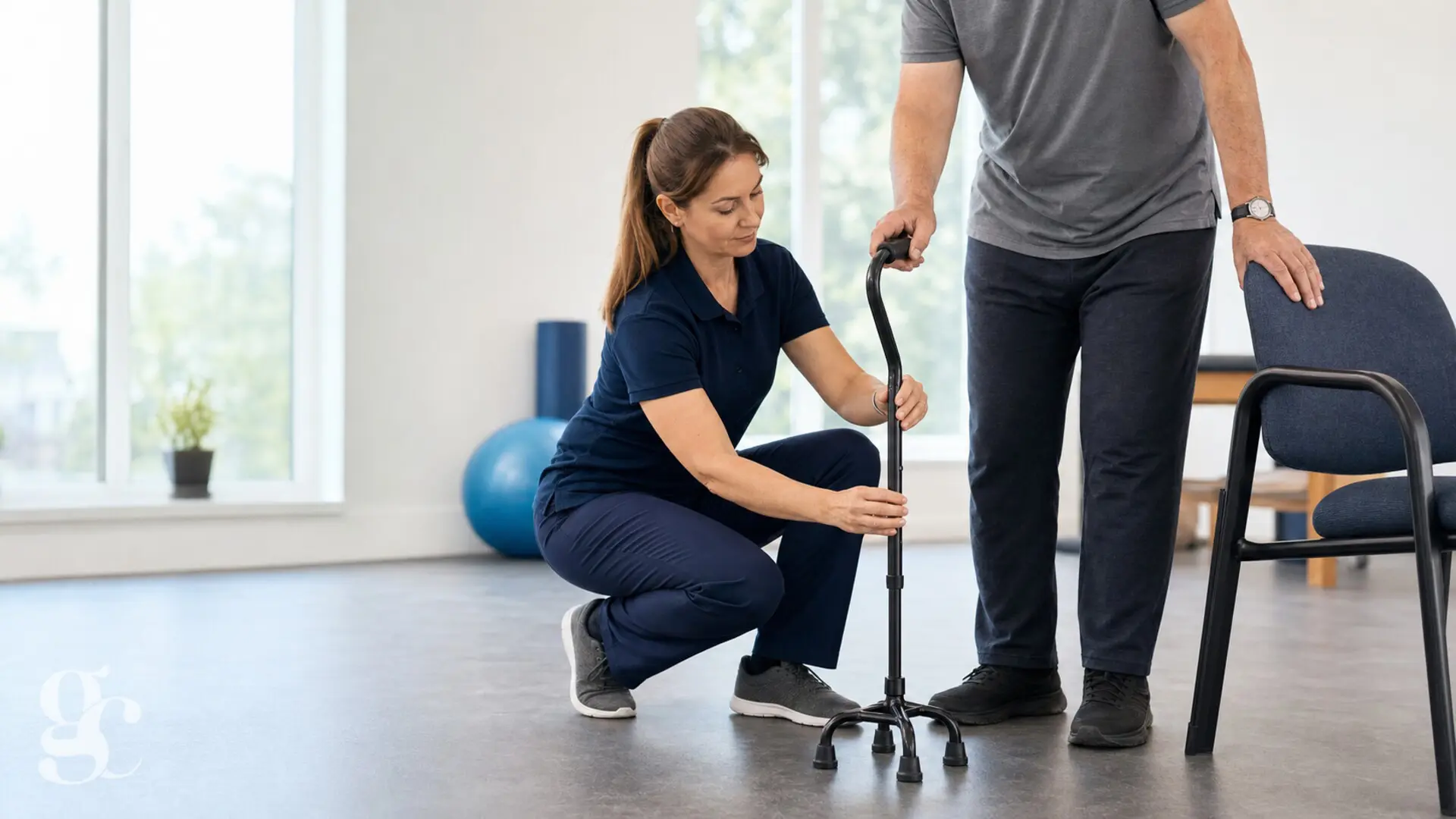
The adjustment is made while wearing the shoes used for walking and in a posture that the professional can observe. Institutional guidelines generally place the handle near the wrist crease when the arm rests at the side, with the elbow slightly flexed when gripping. This recommendation should be adapted to the individual and the device.
After adjustment, the knob must protrude fully into the designated hole, and the locking ring must be secured according to the instructions. Do not add any holes, shims, or tape. A cane that is too high or too low will alter your posture and how the base rests.
Which way should you hold the cane?
A cane is usually held on the opposite side of the weaker, more painful, or surgically operated limb. This guideline is not a rule to be applied solely after every surgery. Arm limitations, weight-bearing instructions, balance problems, or a particular base configuration may alter the decision.
Ask the professional to clearly mark the side and have you try the walking sequence. Do not copy the walking style of a relative. If the cane hits your foot, if your torso leans, or if you have to place it too far back to move forward, stop the trial and have the adjustment checked.
How to orient and lay the foundation?
A base entirely on the ground
All four tips must be in contact with a stable surface before weight is transferred. On a slope, threshold, or uneven ground, part of the base may remain unsupported. The intended benefit is then lost, and the pole may tip over. Do not use the pole on terrain that has not been tested by a professional.
An orientation that frees up the passage of the foot
On an offset base, the widest part must not obstruct the path of the feet. Have the orientation adjusted for the chosen side and verify that the model allows this mounting. Flipping a base yourself, even if it appears symmetrical, can place the handle or fasteners in an unintended position.
Advertising
What elements should be checked before each outing?
- all four tips are present, dry, clean and without significant wear;
- the base shows no twisting, cracking, or abnormal play;
- the height knob and the clamping ring are correctly locked;
- the handle does not rotate and remains comfortable in the hand;
- the capacity indicated by the manufacturer corresponds to the user;
- The ground, the lighting and the shoes allow for the planned route.
Remove from service any cane that is bent, incomplete, or unstable. Do not replace a tip with one of an approximate diameter, and do not repair a crack. Include these checks in your return-home checklist.
How to secure transfers and accommodation?
To stand up, institutional guidelines recommend pushing off the bed or chair rather than pulling on the cane. Once standing and balanced, grasp the handle according to the learned sequence. To sit down, move close enough to the seat and use the armrests as instructed.
Clear away cables, small pieces of furniture, and loose rugs. A four-legged base takes up more space than a single tip and can snag on low obstacles. Good lighting and suitable footwear for recovery complete the setup but cannot compensate for a poorly adjusted aid.
Can it be used on stairs?
Do not attempt to use a four-legged walking stick on stairs alone. The base must rest entirely on the step and may be too bulky depending on the depth, the handrail, and the side of the step. Only a professional who has observed the staircase can teach a proper technique or recommend an alternative setup.
If the accommodation has steps, please report them before leaving. A temporary solution on the same level, assistance from a person, or another aid may be preferable. Purchasing a walking stick does not make stairs accessible on its own.
Advertising
Where can a quadruped cane be safely compared?
GuideChirurgie does not currently offer any merchant links in this guide: the available results do not allow for accurate confirmation of the base, side, height, tips, and capacity of a specific model. We recommend trying it out at a medical equipment supplier or borrowing it from your healthcare facility. For a used product, request a clearly identifiable instruction manual and only replace parts recommended by the manufacturer.
When should I stop using it and seek advice?
- the cane slips, tips over or no longer rests on its four feet;
- pain, swelling or limping increases during walking;
- dizziness, discomfort, weakness or numbness appears;
- you fall or hit the operated area;
- the button, base, handle or end piece has a defect;
- You are no longer able to follow the side or sequence being taught.
Sit down safely and contact the rehabilitation team or professional. In case of significant difficulty breathing, chest pain, loss of consciousness, confusion, sudden weakness on one side, or serious injury after a fall, call 15 (SAMU) in France, or 112 from any European country.
F.A.Q
Is a four-legged walking stick suitable if no support is allowed?
Don't assume it. A single-sided cane does not automatically replace the device designed to protect the limb. Respect the assistance provided and ask for permission before making any changes.
Can we choose the widest base?
Not necessarily. A wide base can offer more surface area but can also hinder foot movement, doorways, or steps. The choice should be made after trying them out.
Does the fact that it stands upright make all uses easier?
No. It can remain on a horizontal surface, but a slight impact is enough to move it. Don't rely on it as a pull-up bar and don't leave it in a passageway.
Verified medical and institutional sources
- Blackpool Teaching Hospitals: Progressive choice of support after knee replacement
- Royal Cornwall Hospitals: Walking aids after hip replacement
- South Tees Hospitals: Adjusting and maintaining a cane
- NHS: Choosing and obtaining a walking aid
- NICE: Individualized fall risk assessment
- Bradford Teaching Hospitals: Control and use of walking aids