A swivel bath seat after surgery can eliminate the need to stand during bathing and reduce the effort required to get over the edge. However, it does not automatically make bathing or transferring the patient possible. The wound, any restricted movements, the balance, and the shape of the bathtub must be checked before purchase.
Start with the discharge instructions and the guide on recovery after surgery at home . A well-constructed model can still be dangerous if it requires rotating the hip, pushing on an operated arm, or sitting on a support that is too low.
Swivel bath seat after an operation: is bathing allowed?
The seat does not protect an incision and does not transform a dressing into a waterproof barrier. The NHS recommends not placing a wound under bath water until it is fully healed or a doctor has given their approval. A short shower may be permitted earlier in certain situations, but individual advice always takes precedence.
Showering while seated and bathing in a full bathtub are not equivalent.
A chair placed on the edge of the tub is primarily used for showering while seated over the bathtub. It does not allow you to get down to the bottom to take a bath. Review the instructions regarding bathing after surgery and the specific postoperative dressing instructions.
Some interventions completely change the choice
After hip replacement surgery, precautions often focus on rotation, deep flexion, and adduction. A swivel chair may be contraindicated if it causes the pelvis to rotate, cross the legs, or positions the patient too low. After knee replacement surgery, bathing may be prohibited for several weeks. Shoulder, wrist, or chest surgery may prevent pushing on armrests. The device should only be used if the medical team confirms the actual movement required for entry and exit.
Advertising
Who is this type of seat suitable for?
It can be considered for a person who is able to sit in a controlled manner, maintain trunk control, and move their legs over the edge, either independently or with the intended assistance. The test must confirm that no prohibited rotation or flexion occurs when sitting down, pivoting, and exiting the bathtub.
Another solution is preferable in cases of dizziness, faintness, transfers requiring lifting, inaccessible bathtubs, or restrictions incompatible with rotation. A shower chair after surgery , washing at the sink, or more significant adaptations can then be discussed.
What measurements should be taken on the bathtub?
Interior width and rim surface
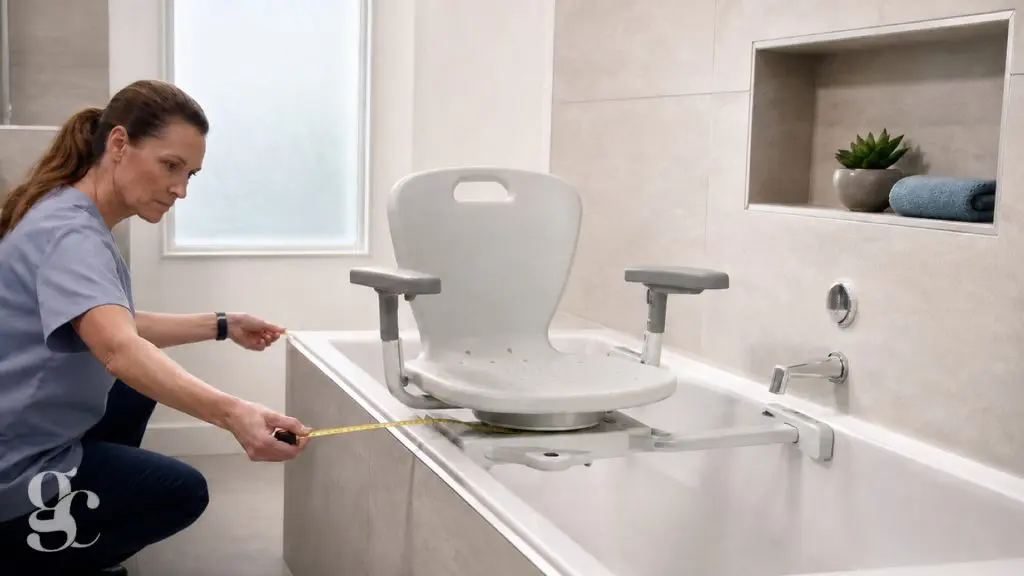
Measure the inside width precisely where the crossbars will rest, in several places if the sides are not parallel. For the Identités 812174, the manufacturer's instructions specify an inside width between 54 and 68 cm. They also require that the four corners rest at least 5 cm on top of the edges.
The edges must allow for four full points of support. A shower screen rail, handle, faucet, sloping edge, or flexible shell can prevent installation. Never correct a lack of support with a shim, board, or excessive tightening.
Size, armrests and legroom
Measure the outside space needed to sit facing the chair, the available knee room, and the clearance between the chair and the wall. Check the width between the armrests and the height of the rim. The person should be able to raise each leg without putting strain on the surgical area or losing their balance.
The guide to making the bathroom safe after surgery reminds us that lighting, flooring and fixed supports are just as important as the seat.
What risks should you check before ordering?
- Bathing or showering is explicitly permitted;
- the transfer technique respects postoperative restrictions;
- the four supports rest entirely on rigid and flat edges;
- the seat can be locked without abnormal play in every useful position;
- the maximum load of the model exceeds the user's weight;
- A loved one can remain present if the balance is uncertain;
- A properly fixed grab bar is accessible without bending over.
A towel rack, faucets, and a bath screen are not considered supports. If the first attempt causes pain, apprehension, or imbalance, stop and ask for an alternative solution rather than repeating the movement.
Advertising
Two specific references to examine after the measurements
Editorial note: The commercial selection was removed on July 19, 2026. One listing was no longer sufficiently defensible without a usable manufacturer's information leaflet for the PEPE P30013, and the other did not maintain a correct tracked link and local product image combination that met our standard of proof. This article therefore remains intentionally without a commercial link until these conditions are met.
How to install and test the seat dry?
Assemble only the parts specified in the instructions. Position the four supports, adjust the stabilizers without deforming the bathtub, then check each screw, clip, and armrest. The chair should remain stationary when light pressure is applied successively to its sides, with no one seated.
Next, do a full dress rehearsal on a dry floor with the person who will be assisting on bath day. The seat should be turned outwards and locked in place before sitting down. The soap, towel, and shower head should remain easily accessible without twisting or deep bending.
What transfer can be made without putting oneself in danger?
- dry the ground and clear the passage;
- lock the seat facing the user;
- move back until you feel the seat behind your legs;
- sit in the center with the permitted supports;
- activate the control and move the legs one by one over the edge;
- release the control and confirm the lock before you start washing;
- Perform the reverse sequence to exit.
Never stand on the seat or fall onto its edge. New postoperative pain , dizziness, or an uncertain locking of the seat requires stopping the transfer.
After hip surgery, before your first attempt, ask if you should avoid pivoting on your operated leg, bending your hip in the lowered position, or bringing your knees together. If the sequence requires any of these movements, do not use the chair without further confirmation.
Advertising
Locking mechanism, maximum load and maintenance: what to check?
Before each use, check that the rotation is smooth and that the mechanism securely holds the seat in the required positions. Excessive movement, imprecise locking, a crack, or a missing part requires that the device be removed from service. Do not attempt an improvised repair.
Keep below the maximum load specified. Wipe and dry the chair after each use. The instructions recommend water and a mild, non-abrasive detergent; regularly inspect the seat, frame, stabilizers, and armrests. Persistent moisture and residue can mask damage.
When to request an occupational therapy assessment?
The occupational therapist assesses abilities, transfers, the environment, and available human assistance. Their opinion is particularly useful after hip or knee surgery, in cases of weakness on one side, limited use of an arm, a recent fall, or an atypical bathing situation.
They may recommend alternative equipment, a properly installed grab bar, or other modifications. The national portal on assistive devices reminds users that untested equipment can increase the risk of falls or be abandoned altogether. For example, a toilet seat riser addresses a different transfer need and should not be chosen based on the same measurements.
When should I contact the team again or call in an emergency?
Contact the team again on the same day or before the first bath if you are unsure whether the bath is allowed, if the transfer requires a prohibited rotation, if you cannot lift a leg without additional help, or if the installation seems unstable despite correct measurements.
After the trial, seek prompt medical advice if you experience sudden pain, a feeling of dislocation, dizziness, bleeding from the wound, or if you are unable to get out of the bathtub using the prescribed method. If you fall, experience difficulty breathing, chest pain, a sudden neurological deficit, or are unable to stand, call emergency services immediately.
F.A.Q
Can the seat be used on its own as soon as we return home?
Not without validation and a trial. Fatigue, pain medication, weakness, and movement restrictions may make the first transfer different from the one performed before the operation. Plan to have someone present if any doubt remains.
Is a heavier model necessarily more stable?
No. Stability depends primarily on the compatibility of the edges, the four supports, the stabilizers, the locking mechanism, and how you sit. The product's weight does not compensate for improper installation.
Verified sources
- NHS: Recovery and hygiene after an operation
- Frimley Health NHS: Precautions after hip surgery
- King's College Hospital: Total Knee Replacement, 2026 Guide
- Identities: Notice 812174, version 2026
- National portal for the elderly: Adapted equipment for washing and transfers
- Health Insurance: Preventing Falls in the Bathroom
- Ministry of Health: Role of the occupational therapist
- National portal for older people: Choosing assistive technology
Editorial note: article verified on July 17, 2026. The instructions of the surgical team, the assessment of the transfer and the instructions for the delivered reference take precedence over this guide.