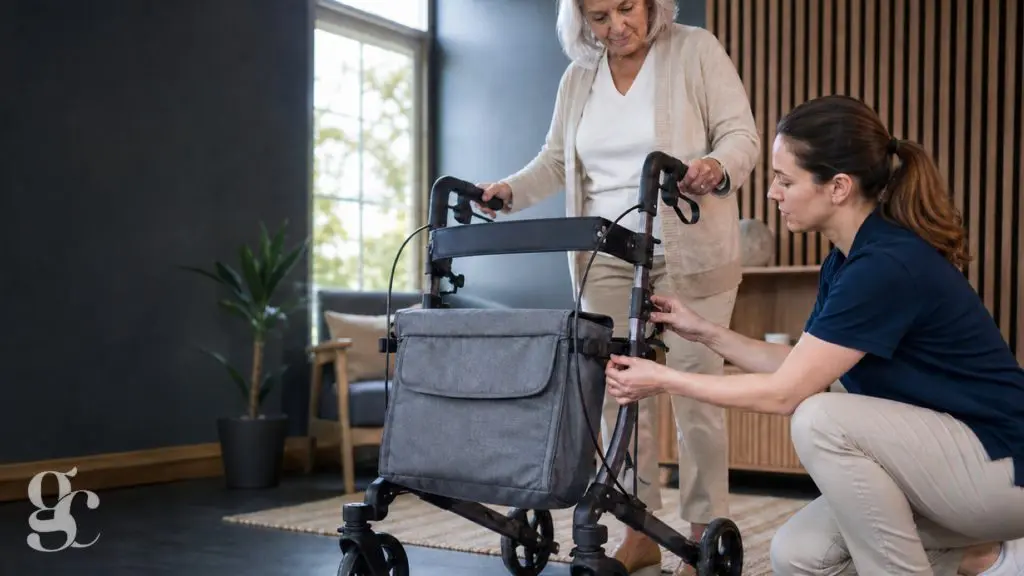
A bag for a walker can free up your hands and keep your phone, glasses, or small items within easy reach. If chosen incorrectly or improperly attached, it can also interfere with the brakes, pull the frame to one side, or get caught in a wheel. Compatibility with the walker model is more important than the number of pockets.
There is no universal maximum weight limit for all bags and rollators. You must read the instructions for both the walking aid and the accessory, then note the lowest limit. If the walker was chosen after surgery , have the assembly checked by the physiotherapist, occupational therapist, or supplier.
Bag for a walker, basket or side bag: which to choose?
The front bag
It is usually placed between the uprights, under the handles. This position can keep the load centered and accessible, provided it doesn't obstruct the crossbar, cables, or folding mechanism. The width and height must correspond to the actual space within the frame.
The basket provided by the manufacturer
A basket designed for this model has identified attachment points and a documented limit. However, it may be heavier, reveal its contents, or make storage difficult. Check if it needs to be removed before folding the walker.
The side bag
A pannier on one side can create asymmetrical traction, especially when full. It's only acceptable if the instructions and mounting allow it, without touching the wheel. Avoid hanging a regular handbag from a handle: it can swing and interfere with the brake lever.
Advertising
How can I check compatibility before buying?
- note the brand, model and year of the walker;
- measure the available space between the uprights without obscuring the mechanisms;
- identify the fixing points authorized by the instructions;
- check the opening, folding and possible removal of the bag;
- check the load limit of the accessory and the walker;
- Prefer a clear return policy if no trial is possible.
The terms "universal" or "for all rollators" do not guarantee compatibility. Compare the dimensions and number of straps to your frame. A catalog photograph may show a different model and obscure a cable located on your side.
What are the four fastening checks?
A bag that is centered and without swaying.
The upper straps secure the bag, but a lower attachment may be necessary to prevent swaying. The fabric must not slip toward a wheel when the frame turns. Load a light item first and observe the bag as you move forward, backward, and change direction.
Completely free brakes
No strap should encircle a lever, compress a cable housing, or pull on a cable. Operate both brakes and the parking brake after assembly. If the travel changes, if a cable rubs, or if a lever does not return properly, remove the bag.
Wheels and a clear folding area
Fully rotate the front wheels and check that no corners, cords, or flaps are touching them. Then fold the walker as instructed. Never force any mechanism against the bag, and do not allow any straps to dangle when the accessory is removed.
Controllable attachments
Velcro, buckles, and seams must remain accessible for inspection. A frayed strap, a loose stitch, or a closure that opens under slight tension requires discontinuation. After washing, reattach each fastener to its designated position and repeat the test.
What is the maximum load that should not be exceeded?
Some rollator instruction manuals specify a limit for their basket, but this value cannot be taken as a general rule. A bag sold separately may have a lower limit, or no documented load capacity. In the latter case, ask the seller for the manual or reject the offer if you intend to carry anything other than very small items.
Weigh the entire contents, including the container. Distribute the items in the center, without placing any heavy bottles on one side. Do not use the bag for bulky groceries, a gas cylinder, protruding equipment, or anything that could shift suddenly. If the frame becomes more difficult to steer or brake, the load is unsuitable, even if a theoretical limit has not been reached.
Advertising
How can I reach the bag without losing my balance?
Stop on level ground, place the walker in a stable position, and engage the parking brakes before opening the bag. Do not search for items while walking. Store your phone, keys, and glasses in an identifiable pocket to avoid bending down or searching for them.
A rollator seat should only be used according to its instructions, with the brakes locked. The bag should not obstruct access to the seat or be used as a handle to stand up. During home pick-up , also place everyday items at an accessible height to minimize handling.
What can be transported without creating a new risk?
- glasses in a closed case;
- a phone and keys in a zipped pocket;
- tissues and small personal items;
- the documents needed for an appointment;
- a treatment in its packaging, protected from heat and according to its storage conditions.
Avoid hot liquids, sharp objects, fragile glass, unstable loads, and loose medications. A grabber should not be carried extending near the wheels and should never be used while walking, as both hands should be on the frame.
Two exact offers to compare with your frame
Commercial transparency: The following two links are affiliate links. They may generate a commission for GuideChirurgie without increasing the price paid. They correspond to the two Amazon listings described. As an Amazon Associate, GuideChirurgie earns from qualifying purchases. No prices or maximum charges are fixed, as this information is subject to change and is not fully documented.
Walker bags to be checked point by point
Compare the dimensions, the frame attachment method, the brake travel, the stability when the bag is loaded, and the return policy. These offers are not valid for all frames.
Product descriptions outline textiles and fasteners, not medical validation. Verify the seller, current sizing, conformity, return time, and policy before ordering. Do not interpret "waterproof" as authorization to carry a sensitive medication or a spillable liquid.
Advertising
Checklist before each outing
- the four fasteners are closed and the bag remains centered;
- both brakes are responding normally;
- no cable, lever, wheel or mechanism touches the textile;
- the content is light, stable and distributed;
- Frequently used items are accessible when stopped;
- no straps hang down towards the ground;
- The route is clear and sufficiently lit.
Appropriate footwear during convalescence and a motion-activated nightlight address other risks. Adding numerous accessories does not replace a comprehensive assessment of mobility and housing.
When should I stop using the bag?
Remove the strap if the walker pulls to one side, if a wheel rubs, if the braking system changes, if the frame doesn't fold properly, or if a strap comes loose. Also have the walker checked if there is any play in the mechanism, a loose screw, an unstable wheel, or after a fall. Do not compensate for a defect with a makeshift strap.
Pain, dizziness, new weakness, or difficulty keeping both hands on the handles warrants stopping and seeking medical advice. The goal is not to carry more, but to maintain as steady a gait as possible.
Verified sources
- Worcestershire Acute Hospitals NHS: Safety of walking aids
- South Tees Hospitals NHS: Using and controlling a gait analysis frame
- Guy's and St Thomas' NHS: Fall Prevention and Walking Aids
- MHRA: Alert on wheels and screws of walking frames
- Trionic: Instructions for a rollator and its basket
- Human Care: Notice and allocation of the burden
- Invacare: Instructions, basket attachment, and model-specific limits
Editorial note: article verified on July 17, 2026. The walker and bag instructions, as well as the professional's assessment, take precedence over this guide.