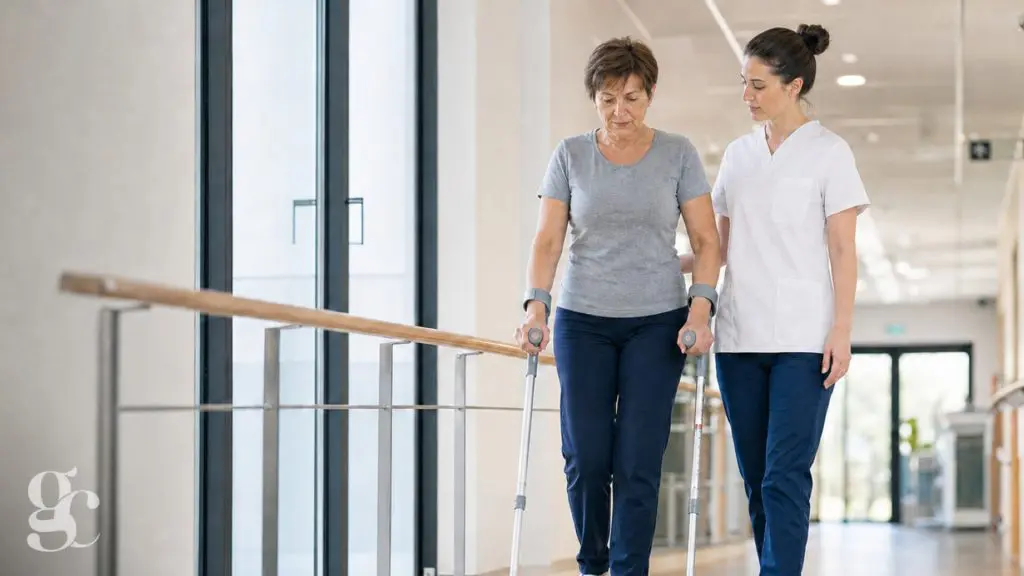
Recovery after hip replacement surgery must follow the discharge summary and the team's instructions. Permitted weight-bearing, movements to avoid, crutches, dressings, and rehabilitation depend on the specific procedure performed and your individual condition. A rapid recovery does not justify exceeding any written restrictions.
This guide primarily concerns recovery after a primary total leg replacement. Revision surgery, a fracture, bone reconstruction, or an incident during the operation can significantly alter the guidelines. If the terms "full weight-bearing," "partial weight-bearing," or "non-weight-bearing" remain unclear, ask for clarification before testing the leg.
Why is there no universal timeline for recovery after a hip replacement?
The surgical approach, implant fixation, bone quality, muscle strength, balance, associated medical conditions, and level of independence all influence recovery. Therefore, two individuals with comparable prostheses may receive different instructions without either approach being incorrect.
Primary prosthesis and prosthesis revision
After a primary prosthesis without any particular difficulties, some teams allow early weight-bearing. After a revision, weight-bearing may be limited to protect the reconstruction and allow for healing. The operative report and discharge prescription will indicate your specific situation.
How to regain support and walking?
The first time getting up should be learned with a caregiver. Then walk within the indicated limits, with the assistance provided, and without trying to cover a specific distance. The goal is a safe gait: regular steps, turns made in several small steps, and no sudden pivoting on the operated leg.
Crutches after surgery must be adjusted and used according to the instructions provided. A single cane is usually held on the side opposite the operated hip, but it does not replace two canes if those are still prescribed. Increasing pain, dizziness, or a feeling of instability requires stopping.
Advertising
Does the approach change the precautions?
After a posterior approach
The team may advise against certain combinations of flexion and internal rotation. A very low seat, crossing the legs, or pivoting to reach for the foot may then be discouraged. These examples are for illustrative purposes only; they do not replace the list provided by the surgeon.
After a previous route
Precautions may be more important when combining posterior extension and external rotation. It would be incorrect to say that the anterior approach eliminates all risk of dislocation. Conversely, imposing the same restrictions on all patients could unnecessarily slow their recovery.
An abduction wedge is not always necessary after hip replacement surgery. Do not purchase any wedge or orthosis without specific instructions regarding the model, position, and timing of use.
How to monitor the scar
The type of closure determines the care required: absorbable sutures , removable sutures, staples , or surgical glue each follow a different protocol. Follow the dressing prescription and shower instructions. Do not remove glue, scabs, or sutures, and do not immerse the wound without permission.
Spreading redness, marked warmth, discharge, persistent bleeding, wound dehiscence, fever, or chills warrant prompt contact with the team. The surgical wound infection file helps prepare for the call but should not delay the evaluation. Do not start any leftover antibiotics from a previous prescription.
Pain, fatigue, hematoma and edema: what to look for?
Pain, fatigue, bruising, or swelling may accompany recovery. Their presence alone does not indicate whether the process is normal. Pay particular attention to the trend, the response to prescribed treatment, and the effect on walking, sleeping, and overall condition. The guide on hematomas after surgery explains the differences between hematomas and active bleeding.
Call if the pain becomes unusual, sudden, significantly worse, unrelieved, or if the swelling increases rapidly. Do not take an anti-inflammatory medication on your own: it may interact with an anticoagulant and mask signs of infection.
Advertising
How to prevent phlebitis without changing the prescription?
Prevention involves, depending on the case, mobilization, anticoagulants, and medical compression. Take the anticoagulant exactly as prescribed, without changing the dose, doubling it, or stopping it on its own. Wear stockings only if they have been prescribed and are properly fitted; information on compression stockings after surgery does not replace measurement or demonstration.
Pain, heaviness, warmth, or swelling, especially in one calf, may suggest phlebitis after surgery . Seek medical advice promptly: the appearance of the limb cannot confirm or rule out a blood clot.
When should you call emergency services immediately?
If you experience new or sudden shortness of breath, chest pain that worsens with breathing, dizziness, loss of consciousness, or coughing up blood, call 15 (SAMU) in France, or 112 from any other European country, immediately. Do not drive yourself. The guide on postoperative shortness of breath should never delay calling emergency services.
How to recognize a possible dislocation?
A dislocation can cause sudden and intense pain, an inability to stand or move the hip, and an unusual leg position or apparent length. Do not attempt to put the joint back in place, do not force yourself to walk, and contact emergency services or a surgical department immediately.
Acute pain following a fall, a sudden movement, or a popping sound also requires evaluation, even if the deformity is not obvious. Position the person as painlessly as possible without pulling on the limb and follow the instructions of the healthcare professional you contact.
What role for physiotherapy?
Resuming walking and daily activities is the foundation of recovery. Some people need regular follow-up to work on transfers, balance, strength, or a limp; others primarily receive exercises to continue independently. The location and intensity of these exercises depend on the individual's level of independence and goals.
Do not add a spectacular exercise found in a video. A movement must respect the support provided, the surgical approach, and the tissues being operated on. If a session triggers abnormal pain, loss of function, or progressive swelling, stop the exercise and seek advice.
When to resume driving, work and sports?
There is no set timeframe that applies to everyone. To drive, you must be able to get in and out of the vehicle, control the pedals, look around, and perform emergency braking without pain or medication that impairs alertness. Seek approval from the team and consult the criteria in the guide to driving after surgery.
Returning to work depends on the commute, lifting, standing, and available workplace adjustments. Sports activities can resume gradually after approval, taking into account previous activity and the risk of impact or falls. A medical examination does not automatically constitute authorization.
How to prepare your home without buying things haphazardly?
Ask the team to observe you performing four actions: getting in and out of bed, sitting down and standing up from the toilet, accessing the shower, and picking up a light object. Restrictions depend on factors such as the route of access, balance, and permitted support. Therefore, a generic shopping list is not a substitute for this trial.
- For the toilet, measure the bowl and the transfer area before considering a toilet seat riser.
- For the shower, check whether it's permitted to wet the area, floor, and supports before comparing a shower chair.
- For the outfit, a gripping clamp It can only help if the technique and length are suitable for your movement.
- For nighttime travel, follow the guidelines for secure the passageways and the bathroom.
Opt for a trial and an exact model number with verifiable instructions, dimensions, load capacity, and return policy. Equipment advertised as "post-operative" or "universal" is not automatically suitable. These buying guides are separate from this medical article and clearly indicate any affiliate links.
Commercial transparency: The image and button below are affiliate links and point to the exact same grasping forceps. GuideChirurgie may receive a commission without changing the price paid. It can assist in grasping a light object only if the team has validated the movement; it should never be used as a support, transfer handle, or to bypass a restriction.
Who should be contacted depending on the observed sign?
| Situation | To behave |
|---|---|
| Shortness of breath, chest pain, dizziness or loss of consciousness | Call 15 (SAMU) in France, or 112 from any European country, immediately. |
| Sudden pain with inability to move or put weight on anything. | Emergency room or surgical department |
| Calf, especially one side, painful, hot or swollen | Quick medical advice |
| Fever, chills, a red, hot, or oozing scar | Contact the team on the same day |
| Pain or swelling that worsens despite treatment | Contact a surgeon or doctor |
| Significant bleeding while taking anticoagulants or feeling unwell | Medical emergency |
F.A.Q
Can we walk as soon as we get home?
Yes, if the walk has been validated, with the specified level of support and assistance. Authorization to walk does not mean abandoning crutches or increasing the distance alone.
When can we stop using canes?
When the team confirms that weight-bearing, balance, and walking are adequate. The disappearance of pain at rest is not sufficient if a limp or instability persists.
Does preventative treatment rule out phlebitis?
No. It reduces the risk without making complications impossible. Report any new symptoms even if you have taken all the prescribed doses.
Verified medical and institutional sources
- French National Authority for Health: Improved recovery after surgery
- Health Insurance: Treatment of osteoarthritis and post-hip replacement care
- Health Insurance: Living with a hip prosthesis
- Health Insurance: Symptoms and diagnosis of phlebitis
- Health Insurance: Pulmonary embolism and emergency call
- Health Insurance: Monitoring and risks of anticoagulants
- SOFCOT: Patient information sheet on total hip replacement
- SOFCOT: Patient information sheet on revision total hip replacement
- Toulouse University Hospital: Information booklet on total hip replacement
Transparency: None of the links in this article are affiliate links. No products, exercises, or treatments are recommended for purchase.
Editorial note: This general information article was verified on July 17, 2026. It does not replace the discharge summary or the surgical team's assessment. Support, care, movement, and resumption of activities must remain individualized.