A car transfer handle can create a support point for sitting down or standing up. A high advertised load capacity is not enough: the latch, vehicle manual, orientation, and the user's abilities all matter.
After surgery, an accessory may encourage an inappropriate movement or put strain on a painful arm. Prepare for your journey with the team and our guide to post-surgery recovery at home . This guide does not replace an assessment of passenger-side transfer or advice regarding your ability to resume driving.
How does a car transfer handle work?
The metal end piece is inserted into the strike plate of the door frame when the door is open. The handle then provides support during the sit-to-stand transition and must be removed after each transfer.
The CRAMIF specifies that it is for support purposes only. It is neither a hoist nor a permanent bar. If it is necessary to hang from it or pull the person, another solution must be considered.
Advertising
How to check compatibility with the vehicle?
Identify a suitable U-shaped strike plate
The Stander HandyBar 3001 requires a U-shaped strike plate secured with two screws or bolts, not a simple bolt. Appearance alone is not enough: strength, angle, and clearance vary depending on the vehicle.
Read the vehicle's manual before consulting the sales brochure.
Read the sections on doors, locks, and accessories. Ford, for example, prohibits using the door latch for handles or steps, as this could damage the vehicle. This instruction takes precedence over advertising.
Examine the condition and available space
Remove any loose, deformed, corroded, or damaged strike plate. The nozzle should fit completely without forcing against a sensor, seal, or bodywork. If in doubt, consult the manufacturer.
Why is the advertised charge insufficient?
The HandyBar 3001 is listed at 350 pounds, or approximately 159 kilograms. The CRAMIF (Regional Health Insurance Fund of Île-de-France) uses a weight of approximately 155 kilograms for this product line. These figures do not guarantee the safety of the latch or its dynamic movement.
A sudden or angled impact differs from a regular load. Do not assume safety solely based on the proximity of the person's weight to the stated limit. The manual and instructions remain the primary reference.
In what situations can this assistance be considered?
It can be considered if the person can control their seat, stabilize their feet, understand the sequence, and bear weight without pain. In most post-operative situations, its initial use involves transferring to the passenger side of the vehicle to return home. It can complement the transition to a walking aid after surgery.
It is not automatically suitable for use from a wheelchair: brakes, footrests, and the distance between the seats all change the risk. The walker should be stored out of the way.
Advertising
Why seek advice after an operation?
The upper limbs may be involved.
After shoulder, wrist, breast, chest, or abdominal surgery, pulling or pushing may be prohibited. Ask which arm to use and what level of exertion is permitted.
Leg support and balance remain crucial.
Limited weight-bearing capacity, dizziness, weakness, decreased sensation, or involuntary movements increase the risk of falling. A four-legged walking stick after surgery should only be used according to the learned sequence.
After hip surgery, restrictions vary. No single angle or generic timing is suitable for everyone. The grip should not cause pivoting on one foot, crossing legs, or falling onto the seat.
What should the trial with an occupational therapist verify?
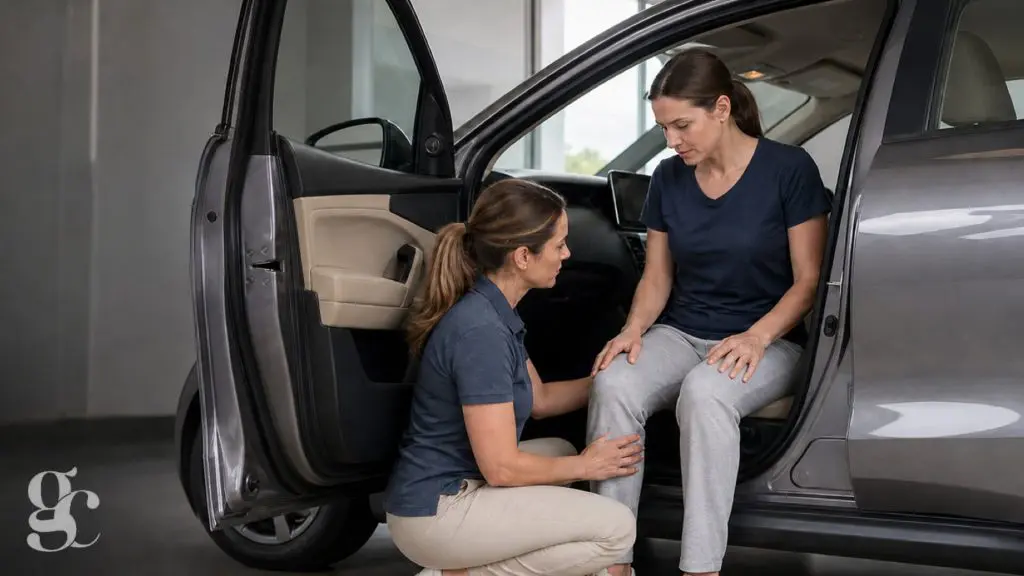
The practical test takes place with the car actually in use, not just with the product in the store. The occupational therapist observes the seat height, the door opening, the legroom, the hand grip, the direction of effort, and the transition to the walking aid.
- Does the person understand each step without rushing?
- Do the feet remain stable before standing up?
- Does the support respect postoperative restrictions?
- Does the handle remain stationary under progressive pressure?
- Can the caregiver secure the person without pulling them?
- Would another form of assistance be simpler or more stable?
The NHS advises seeking professional advice before purchasing transfer equipment and trying it out. The demonstration should include both entry and exit, as the movement and points of support are not the same.
How to prepare for the transfer in the car?
- park on a flat surface, with enough space to open the door;
- use the seat location and setting indicated by the team;
- move the seat back if this makes it easier to pass without breaking any rules;
- secure the door if it can swing back due to the wind or slope;
- place the walking aid in the learned location, without creating an obstacle;
- check the latch and insert the handle according to its instructions;
- test a light pressure before initiating the movement;
- Remove and store the handle once the transfer is complete.
For a same-day return, also plan ahead for the accompanying person, the vehicle and the discharge instructions using our page on the first night after outpatient surgery.
Advertising
Transfer handle and steering wheel control: two separate decisions
A grab handle to help with passenger-side entry does not authorize driving. Resuming driving depends on the surgeon's instructions, the anesthesia, pain medication, the ability to brake in an emergency, and control of the operated limb. Keep these two topics separate upon discharge.
If no instructions are given, consider the priority to be a safe transfer to the location approved by the team, with an escort. Regarding driving, explicitly ask which day to resume, what type of journey, and what any restrictions may apply.
What errors make the support unstable?
- buy based on the single word "universal";
- partially insert the nozzle or leave it at an angle;
- hanging from the handle instead of taking gradual support;
- to use it on a strike plate prohibited by the manufacturer;
- leave the door free to move during the maneuver;
- forget to remove the accessory before closing the door;
- leave it loose in the passenger compartment while driving.
The CRAMIF recommends a perpendicular position to the seat when the configuration allows: at an angle, stability is reduced; parallel, the accessory may encroach on the transfer space. However, follow the instructions for the exact model and abandon the use if the two requirements are not compatible.
Which purchasing criteria are actually verifiable?
- a manufacturer, a model and a reference clearly identified;
- instructions accessible before ordering;
- the type of strike plate and compatible orientation;
- a capacity derived from the notice, not just from the commercial title;
- a non-slip handle adapted to the user's hand;
- return conditions allowing for a cautious test;
- an identifiable guarantee and product manager.
Avoid generic products where the brand, instructions, or charge vary from page to page. GuideChirurgie does not include any commercial links here: no specific French offer was sufficiently verifiable at the time of writing. Prepare for larger purchases with the packing and home return checklist.
What are the alternatives if the strike plate is incompatible?
The alternative depends on the problem to be solved: a soft grab handle fixed to a designated point, a swivel cushion, a transfer board, a swivel seat, an access step, or an adapted vehicle. These products do not all have the same requirements, and some require professional installation.
Sometimes, adjusting the seat, choosing a different seat, or arranging for human assistance is all that's needed. The goal isn't to accumulate accessories, but to achieve a repeatable movement that respects the vehicle, the individual, and the intervention guidelines.
When should I stop the trial and contact the team again?
Stop if the handle moves, the latch deforms, your hand slips, or if the movement triggers new pain, dizziness, weakness, or discomfort. Do not repeat the test to "get used to it" without understanding the cause.
Contact the team if you are unable to enter or exit using the planned method, if your abilities have changed since your last outing, or if your caregiver is unable to ensure a safe transfer. Difficulty transferring may warrant a further assessment or adapted transportation.
On the day of the operation, contact the team or the designated discharge number immediately if the transfer becomes impossible, if you experience sudden pain, faintness, or unusual weakness. In case of distress, a fall with inability to get up, chest pain, shortness of breath, or a sudden neurological deficit, call emergency services immediately.
F.A.Q
Is the handle suitable for all cars?
No. The U-shape is only a first filter. The vehicle's manual may prohibit the use of an accessory on the latch, even if the end appears to fit correctly.
Can you suspend your entire weight on it?
No. The CRAMIF describes use by support. A stated capacity does not transform the handle into a lifting device and does not certify the car's strength.
Can it be left installed during the journey?
No. It must be removed after the transfer and stored in a closed compartment before the door is closed and departure is made.
Official and primary sources verified
- CRAMIF: Guide to technical aids dedicated to mobilization
- Stander: Support and features of the HandyBar 3001
- Ford: Kuga Owner's Manual, Warning Regarding Accessories on the Latch
- Frimley Health NHS: Getting in and out of a car
- NHS: Evaluation and testing of transfer equipment
- Oxford University Hospitals: Car Transfer Guide
Editorial note: General information article verified on July 17, 2026. It does not replace the vehicle manual, the accessory manual, or the assessment of the team familiar with the procedure.