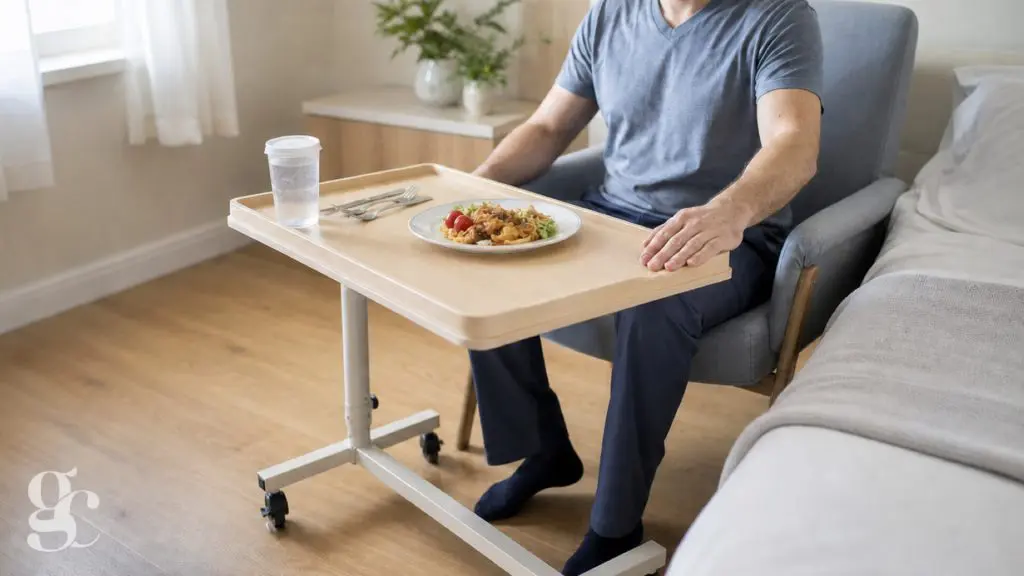
A non-slip tray can make mealtimes easier during recovery, but two different types of slippage should be avoided: the plate on the tray and the tray on the table. A textured surface doesn't guarantee stability underneath, especially on an adjustable bed table.
Before purchasing, measure the available flat surface and review any movement or weight-bearing restrictions. A bed table for convalescence must be level, locked in place, and suitable for the total weight of the meal. A tray will not compensate for an unstable table.
Why choose a non-slip tray during convalescence?
Pain, fatigue, a less available hand, or restricted bending can make carrying and setting up meals more difficult. A smooth tray can shift with the slightest pressure; an oversized one can overhang the table and hit the bed. A heavy tray increases the effort even before adding the plate.
The goal is not to eat in bed by default, but to create a stable surface when the usual sitting position is not yet possible. The guide to post-surgery recovery at home helps organize the space and provides support from a loved one.
Advertising
What dimensions need to be measured?
- the actually flat width and depth of the table;
- the space occupied by the edges, hinges or controls;
- the diameter of the plate and the placement of the glass;
- the necessary space for cutlery without it overhanging;
- the opening of the handles and the space to grip them.
A tray approximately 45 by 32 centimeters is generally suitable for a compact meal, while a 35 by 27 centimeter tray is better for a snack or a small plate. These guidelines are not a substitute for your measurements. Leave some extra space on all sides.
Top, bottom and rim: three different functions
The upper surface
It limits the movement of the plate or glass. Check that it remains effective when clean and dry, and that it doesn't require an unintended disposable coating. A very deep texture can trap crumbs and make cleaning more difficult.
The underside of the tray
It should adhere to the table without sticking or leaving any residue. A product whose top surface is described as non-slip may still slide around. Test the underside on your actual table material, first without the product and then with a closed, cold bottle.
The flange
A low rim holds cutlery or small objects, but doesn't protect against burns and won't necessarily stop a spilled drink. It shouldn't get in the way of the forearm or require lifting the plate high. The total height of the product isn't necessarily that of the rim alone.
Are the handles actually useful?
Two integrated handles allow for a symmetrical grip, provided your fingers fit comfortably and the edge is not sharp. Test the tray empty. After breast, shoulder, or wrist surgery, or if you have weight restrictions, do not carry it yourself without prior approval.
A person walking with a cane, crutches, or a walker needs their hands for support. The tray should not be carried while walking. Ask a relative to help with it, especially after outpatient surgery.
Advertising
How to check for food contact
If food may come into direct contact with the surface, look for a food contact compliance statement or the appropriate symbol, as well as any temperature and usage restrictions. A single marketing claim such as "BPA-free" does not guarantee the product's overall compliance.
Using a plate and glass does not mean you can neglect checking the material: cutlery or food can fall onto the surface. A strong, persistent odor, deformation, cracks, or peeling coating are reasons to discontinue use and contact the seller.
Two exact models to compare
Transparency: The following links are affiliate links. They may generate a commission for GuideChirurgie without increasing the price you pay. As an Amazon Associate, GuideChirurgie earns from qualifying purchases. Product details are accurate, but prices, sellers, and stock availability may change. Double-check dimensions, return policy, and instructions before ordering.
Non-slip trays: two models to compare
Kesper 77201: two handles, non-slip top and bottom, manufacturer's declaration for food contact. Fishtec, set of two: advertised non-slip surfaces top and bottom; check dimensions and available space.
The Kesper was the best-documented option at the time of testing. The smaller Lacor might be suitable for compact use, but its handles and non-slip base are not as well-documented. Neither model is recommended for use on a lap or a duvet.
How do you set up a meal on a bed table?
- Place the table on a flat surface and lock its casters;
- place the tray perfectly horizontally;
- center the tray without obscuring a control;
- place heavy objects near the center;
- use a stable glass, moderately filled and, if possible, closed;
- approach the table without compressing the operated area;
- remain upright according to the team's instructions.
Do not apply very hot liquids if hand function, sensation, or balance are impaired. Resuming eating also depends on the procedure and individual tolerance. Our guide, " What to Eat After Surgery," reminds you that discharge instructions take precedence.
Advertising
How to clean without damaging the adhesion?
Quickly remove any stains with a compatible product, rinse if instructed, and dry both the top and bottom thoroughly. A greasy or damp film reduces adhesion. For the Kesper, the manufacturer's documentation specifies hand cleaning: a marketplace listing should not imply that dishwasher use is permitted.
Inspect the corners, handles, rim, and non-slip area. Remove the tray if it cracks, warps, or has a sticky or uneven surface. Do not cover any defects with adhesive that will come into contact with the dishes.
What test should be performed upon receipt?
Check the part number and dimensions before removing any unnecessary protective coverings. Place the empty tray on the locked table, gently push it in from several sides, and check the handles. Then add a closed, cold bottle and an empty plate.
Return the product if the underside is slippery, if the platform tilts, protrudes dangerously, or requires an effort incompatible with your instructions. For online purchases, check the return period, the required condition of the product, and who is responsible for return shipping costs. The legal guarantee covers a lack of conformity, not an error in dimensions that were not verified.
When should you ask for help rather than change platforms?
Ask for help if you cannot move the table, use both hands, remain upright, or carry the meal without pain. Coughing while drinking, choking, a wet voice, or difficulty swallowing requires professional advice; a rim or lid does not treat a swallowing disorder.
Any new pain, dizziness, weakness, or drowsiness during a meal warrants stopping and ensuring the situation is safe. Prepare your phone, water, and medications according to your prescription in advance; the post-surgery pill organizer guide reminds you never to change their arrangement without prior approval. Do not allow a loaded tray to block the passageway.
F.A.Q
Can the tray be placed on an inclined table?
Not for a meal. Level the surface and lock it. The grip should not compensate for a slope.
Is a non-slip tray always dishwasher safe?
No. Follow the instructions for the exact reference. Heat and chemicals can damage some anti-slip areas.
Verified sources
- DGCCRF: Materials in contact with foodstuffs
- European Union: Regulation on food contact materials
- Anses: Domestic hygiene and surface cleaning
- Kesper: Declaration of conformity for trays 77201 and 77207
- Kesper: Manufacturer's Catalog 2026
- HMS Vilgo: Example of a bed table and limitations specific to the model
- Public Service: Right of withdrawal and legal guarantee
- North Tees and Hartlepool NHS: Position during meals and drinks
Editorial note: article verified on July 17, 2026. Post-operative instructions, table instructions and tray instructions take precedence over this guide.