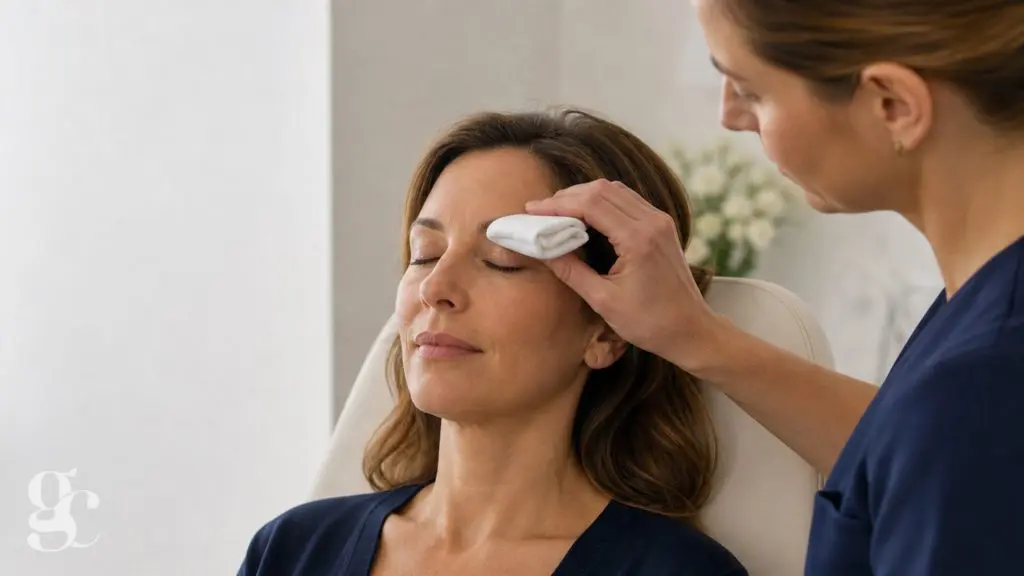
A cold mask after eyelid surgery should only be used if authorized by the surgical team. Blepharoplasty, eyelid repair, skin grafting, orbital surgery, laser treatment, and lipofilling do not automatically follow the same protocol.
Cold can sometimes provide comfort, but it does not, on its own, prevent complications. The device must remain clean, protected by a cloth, and placed on the closed eyelid without applying pressure to the eye, scar, sutures, or graft.
Visual emergency: a sudden decrease in vision, new double vision, intense or increasing eye or orbital pain, an eye that appears to protrude forward, significant bleeding, or rapidly asymmetrical swelling require immediate contact with the ophthalmology department or emergency room. If the team cannot be reached or if the condition deteriorates rapidly, immediately call 15 (SAMU) in France, or 112 from any European country. Do not drive yourself.
Why isn't a cold mask automatically used after eyelid surgery?
The surgeon chooses their instructions based on the technique, skin condition, sensitivity, type of closure, and risk of bleeding. Recommendations following eyelid blepharoplasty should not be applied to orbital surgery or eyelid reconstruction.
Skin graft and flap
After a graft or flap procedure, cold therapy may be discouraged to avoid altering blood flow or putting pressure on the reconstructed area. The department's written instructions take precedence, even if a cold mask was recommended during a previous procedure.
Lipofilling and periocular procedures
A procedure around the eye may require avoiding any local pressure. A bag or mask that seems light can become constricting when held in place by a strap or when worn while sleeping. Do not assume that authorization is granted based solely on commercial advice.
Advertising
Cooling compress, cold pack and gel mask
A cold compress often allows for controlled contact and easy removal. A cold pack is heavier and can conform to the shape of the globe. A gel mask sometimes adds a strap, seams, or rigid areas. These items are therefore not interchangeable.
The information sheet on using a cold pack after surgery explains why temperature, skin integrity, and sensitivity must be taken into account. For the eyelids, the proximity to the eye makes caution even more important.
What should you check before the first application?
- Does the document given upon discharge from the hospital explicitly authorize the application of cold?
- Does the area contain a graft, flap, exposed sutures, or a special dressing?
- Is the skin intact and sensitive enough to perceive a burn or pain?
- Is the device clean, flexible, intact, and leak-free?
- Is a clean textile protection provided between the cold and the skin?
- Can you hold it without a strap and without pressing on the eyeball?
If you don't get an answer, call the surgery department rather than trying to figure it out yourself. Also, keep the on-call number with your home recovery documents.
How to protect the skin and eyes?
Always a clean barrier
Ice or anything very cold should not come into direct contact with the skin. Use the protective covering indicated by the team. The eyelid must remain closed, with no product running into the eye. Do not moisten the incision or apply cream under the dressing without instructions.
Observe the skin during use
Stop use if the skin turns noticeably white, becomes very red, painful, burning, or numb. Reduced sensation may make it difficult to recognize a cold injury. Do not continue application simply because the device feels less cool.
Advertising
No pressure should be applied to the eyeball or the stitches.
The device should be supported by the hand and removed as soon as it becomes uncomfortable. Avoid any tight straps, significant weight, or any position that traps the mask between the face and the pillow. The post-operative sleeping guide reminds users that their position should follow the instructions for the procedure performed.
Do not sleep with the mask on and do not ask a loved one to press on it to "help the cold penetrate better." New pressure, even if painless, is not a test of the scar's strength.
Hygiene: avoid contaminating the surgical area
Wash your hands before handling the device. Use clean protective equipment and store the mask in a dedicated container, away from raw food or contaminated surfaces. Do not share a gauze pad or mask with another person.
Increasing redness, discharge, an unusual odor, fever, or worsening pain may warrant medical attention for a possible surgical site infection . Cold should not be used to mask these signs.
When should I stop the cold application and call the team?
- new pain or pain that increases during application;
- burning sensation, very pale, very red or numb skin;
- bleeding, opening of the wound or fluid reaching the eye;
- swelling which quickly becomes asymmetrical;
- recently appearing blurred vision, double vision, or difficulty opening the eye;
- significant eye redness, discharge or unusual light sensitivity.
Describe the time of onset, the affected side, the progression, and any other symptoms. Postoperative pain that changes or intensifies warrants evaluation, even if it appears outwardly reassuring.
What criteria should be checked if the team authorizes the purchase of a mask?
If the team approves a purchase, check the product description for a clearly identifiable device that can be cleaned according to clear instructions and held comfortably in the hand without a strap or pressure. Don't buy based solely on comfort.
Commercial transparency: The image and button below are affiliate links and redirect to the same exact product page. GuideChirurgie may receive a commission without changing the price paid. This product page shows an eye mask marketed as hot/cold; it does not validate its use after your procedure or a cold protocol. The hot function is excluded in the immediate postoperative period , and the cold function should only be used after approval from the surgical team, with a clean textile covering, and without applying pressure to the eye, incision, or graft.
F.A.Q
Does cold necessarily reduce swelling?
No. It may be part of certain comfort protocols, but the outcome varies and it does not treat a complication. Any worsening of the condition must be reported.
Can a mask that has been stored in the freezer be used?
Only if the team authorizes it and if the instructions, protection, and temperature achieved are compatible with their guidelines. A device that is too cold can damage the skin.
Is blurred vision always normal?
No. Some surface treatments can temporarily blur vision, but a new, significant decrease in vision, or one associated with pain, double vision, or asymmetrical swelling, requires immediate medical attention.
Advertising
Verified sources
- French Society of Ophthalmology: Information sheet on blepharoplasty.
- AP-HP Henri-Mondor: Advice after blepharoplasty.
- Royal Free London: Post-eyelid surgery care.
- Cambridge University Hospitals: Blepharoplasty.
- Guy's and St Thomas': During and after a blepharoplasty.
- American Academy of Ophthalmology EyeWiki: Upper Eyelid Blepharoplasty.
- American Academy of Ophthalmology EyeWiki: Retrobulbar Hemorrhage.
Editorial note: General information article verified on July 17, 2026. The instructions of the surgeon and the institution take precedence over this guide.